Burning the Margin: The Fuel Arithmetic Behind the Doolittle Raid
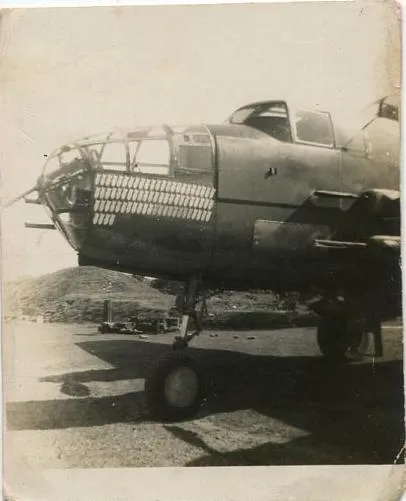
Photo: State Archives of North Carolina Raleigh, NC, No restrictions, via Wikimedia Commons
The Doolittle Raid is usually told as a story of audacity: sixteen B-25s, a carrier deck, a one-way ticket over Tokyo. That framing is true, but it is incomplete. Strip the legend away and what remains is a ledger. The raid was settled not in the cockpit but on paper, in a series of tradeoffs between weight, distance, wind, and time that left almost nothing in reserve. Animate the fuel burn hour by hour and the mission stops looking like a gamble and starts looking like a calculation made in the shadow of a very thin margin.
A Bomber Asked to Carry More Than It Was Built To
The B-25B Mitchell was a sturdy medium bomber, but it was not designed to lift off a carrier or to cross an ocean without a place to land. Every modification made to the aircraft for this mission cut in two directions, and the animatic makes that tension visible.
The ventral gun turret came out. The radio operator's equipment came out, replaced in practice by a pair of improvised aluminum sights—the "Mark Twain" bombsight—that cost almost nothing in weight and everything in complexity. In place of the deleted hardware went fuel: an auxiliary tank fitted into the vacated bomb-bay space, plus a cluster of small cans that could be poured into the system in flight. The result was a bomber carrying roughly a thousand gallons and change, several hundred miles of range beyond its factory figure, and almost no ability to defend itself from below.
That is the first lesson the animation should teach: the raid's extra range was purchased with hardware removed, not with engineering magic. Each gallon of added fuel was paid for in survivability.
The Deck Run and the Wind That Counted as Fuel
A B-25 needs a runway. The Hornet offered roughly five hundred feet of deck and no catapult. The margin came from the ship itself: a carrier steaming into a stiff wind at speed creates a headwind over the deck, and that wind is functionally free airspeed. In effect, the task force was topping off the bombers with velocity instead of gasoline.
This is where the arithmetic gets interesting. Launch wind over deck was not a convenience—it was a variable that had to be spent carefully. A slower ship or a lighter breeze would have required a longer deck run, which in turn would have demanded a lighter aircraft, which would have meant less fuel or fewer bombs. The chain of dependencies runs in both directions, and a good animated diagram can show it as a single closed loop rather than a list of fun facts.
The Picket Boat That Cost Sixteen Planes Some Gasoline
The plan called for launching about four hundred miles from the Japanese coast, a distance chosen precisely because it sat inside the aircraft's calculated reach. On 18 April 1942, lookouts spotted a Japanese picket vessel, and the decision was made to launch early—well over a hundred miles farther out than intended.
That single decision moved every subsequent calculation in the wrong direction. Aircraft that had been briefed on a shorter leg were now committed to a longer one, with the same tanks, the same bombs, and the same engines. There was no way to recover the difference at altitude. The only remaining levers were throttle setting, altitude, and airspeed—and all three were already pinned near their limits by the need to arrive over the target in daylight.
Time Was Also Fuel
Fuel burn is usually discussed in miles per gallon, but for this mission the better metric is gallons per hour, because the raid's true constraint was clock time. Two engines turning at a lean cruise consume on the order of a hundred gallons or more each hour, meaning the entire load was theoretically gone in about ten hours of flight—before accounting for climb, formation maneuvering, or the low-altitude run over the Japanese mainland that cost more per mile than a high cruise would have.
The crews flew deep into the afternoon and then into the night. Some crossed the China coast with gauges reading empty or near it. Several aircraft ran tanks dry outright, and more than one engine quit for lack of fuel rather than enemy action. The animation should linger on that sequence, because it is the clearest possible visual argument that the mission was not won by heroism alone: it was won by crews who understood exactly how many minutes of engine time they had left and spent them deliberately.
Navigation Without a Safety Net
The final variable was the one no engineer could control. The bombers flew in radio silence, without reliable position fixes, relying on dead reckoning and forecast winds that did not always arrive as promised. A headwind of even fifteen knots sustained over four hundred miles is not a rounding error—it is a substantial fraction of the reserve, and it accumulates invisibly.
When the weather cooperated, the math worked. When it did not—and over the East China Sea that April night, it often did not—crews found themselves trading altitude for distance, jettisoning equipment, and choosing between bailing out over land and ditching in water. The navigational uncertainty and the fuel uncertainty were the same problem wearing two hats.
Reading the Ledger Correctly
The Doolittle Raid's material results were modest: a handful of bombs on industrial targets, damage that Japan repaired quickly, and the loss of nearly every aircraft committed. Its strategic results were enormous, which is precisely why the mission is so often told as a story about spirit rather than about arithmetic.
But the arithmetic is what makes the story credible. Sixteen crews did not simply fly west and hope. They flew a mission whose limits had been calculated in advance, whose modifications existed solely to move a line on a chart, and whose margin of error was measured in minutes of engine time. Set that ledger in motion—tank by tank, hour by hour, mile by mile—and the famous flight over Tokyo becomes something more interesting than a legend. It becomes an engineering decision, made once, and then lived out over the Pacific by men who knew exactly how little was left.