The Fish That Turned on Its Own: Animating the Mark 14 Torpedo's Deadly Circle
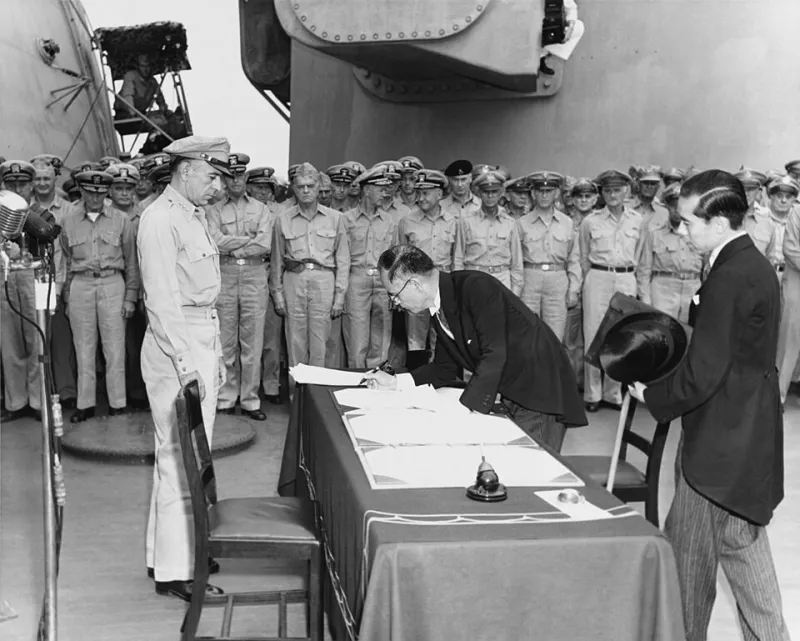
Photo: Army Signal Corps photographer LT. Stephen E. Korpanty; restored by Adam Cuerden, Public domain, via Wikimedia Commons
A submarine captain in the Pacific did not simply aim a torpedo. He placed a bet. The Mark 14 torpedo, the U.S. Navy's standard submarine weapon at the start of the Pacific War, was supposed to settle that bet with mechanical precision. Instead, as an animated cutaway makes clear, it carried three separate ways to fail — and one of them could bring the weapon back to the firing boat.
Three Defects, One Weapon
The first animated sequence isolates the Mark 14's depth-control mechanism. In theory, a hydrostatic valve sensed water pressure and leveled the torpedo at a set depth. In practice, the weapon frequently ran several feet deeper than ordered. Against a surfaced freighter with a shallow draft, a torpedo set to run at ten feet might pass beneath the target entirely. The animation overlays a wireframe hull, a running torpedo, and a depth trace that slides below the intended line, turning a firing solution into an exercise in guesswork.
The second sequence examines the Mark 6 magnetic exploder. Designed to detonate beneath a ship's keel, where a hull is most vulnerable, the exploder depended on the earth's magnetic field being disturbed by a large steel mass. In the waters off Japan and in high latitudes, the local magnetic field behaved differently than the designers had assumed. Torpedoes exploded early, failed to explode at all, or detonated harmlessly against a hull. The cutaway shows the influence exploder as a compact assembly of coils and a firing pin — a clever idea wrapped around an untested assumption.
The third sequence is the one that gives the weapon its grim reputation: the circular run. If the torpedo's gyroscope jammed or its steering mechanism failed after launch, the weapon could turn back along an arc and return toward the submarine. The animation follows a torpedo outbound, then traces its curved path back across the firing point. There is no dramatic music in this segment, only the sound of a propeller and the slow geometry of a weapon closing on the boat that launched it.
The Circle Run as a Human Problem
A circular run was not merely a mechanical curiosity. It converted the submarine from hunter to target in the span of a few minutes. Crews reported hearing torpedoes pass close aboard; some boats endured the weapon's return without knowing whether the next sound would be an impact. The animation reconstructs one such patrol from the control room's perspective: the firing order, the periscope observation, the wait, and then the growing awareness that the torpedo's bearing is wrong.
The historical record includes several losses and near-losses attributed to circular runs. USS Tullibee was lost in 1944 after one of her own torpedoes curved back; USS Tang, already the subject of a separate Pacific War Animated autopsy, suffered a similar catastrophe in the Formosa Strait. These cases are often told as dramatic anecdotes. The cutaway format treats them as engineering evidence. A weapon that can reverse its direction is not simply unlucky. It is a system with a failure mode that designers must anticipate, test for, and mitigate.
Bureau of Ordnance Confidence
The Mark 14's troubles persisted longer than they should have because the U.S. Navy's Bureau of Ordnance trusted its own design assumptions more than it trusted reports from the fleet. The bureau had developed the torpedo at the Naval Torpedo Station in Newport, Rhode Island, and its magnetic exploder was treated as a closely held technical advantage. Live-fire tests against realistic targets were limited by cost and secrecy. When submarine commanders returned with complaints, the bureau tended to blame the shooters rather than the weapon.
An animated organizational timeline helps explain the delay. Reports from the Pacific arrive; the bureau responds with skepticism; modifications are proposed and resisted; the circle of evidence tightens only as more boats fail. The sequence is not a story of a single villain. It is a study in institutional inertia, where a weapon's reputation becomes entangled with the reputation of the institution that built it. The Mark 14 was eventually fixed through a combination of depth-setting changes, deactivation of the magnetic exploder, and improved gyro mechanisms. The fixes arrived after years of war, not months.
What the Cutaway Teaches
Pacific War Animated's reconstructions are not meant to replace the archival record. They are meant to make mechanical cause and human consequence visible in the same frame. When the cutaway shows a torpedo running deep, the viewer sees a missed target. When it shows a circular run, the viewer sees a crew waiting in a steel tube, listening to the sound of its own weapon returning.
The Mark 14 story endures because it is about more than a faulty torpedo. It is about the cost of untested confidence, the difficulty of hearing feedback from the field, and the way technical systems can betray the people who depend on them. The animation does not resolve those questions. It simply places them in motion, one torpedo track at a time.