Five Pacific War Shortcuts That Animation Can Retire
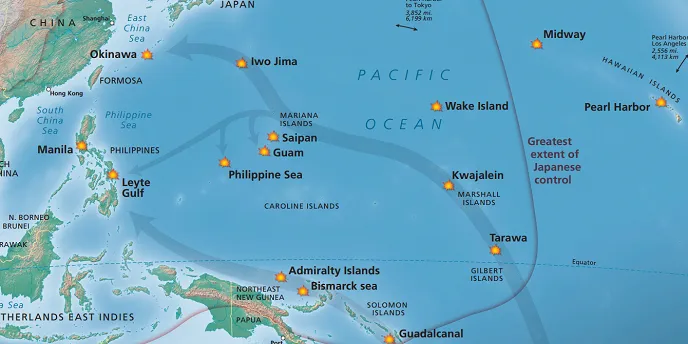
Photo: National Park Service, Public domain, via Wikimedia Commons
Every war acquires a set of approved abbreviations — phrases short enough to fit a narrator's pause, tidy enough to survive a textbook caption. The Pacific War has more than most, partly because its geography is hard to hold in the mind and partly because Hollywood got there first.
Some of these shortcuts are harmless. Others quietly distort what the war was, who fought it, and why it ended. Below are five that we think animation is uniquely suited to retire, because each one fails not on interpretation but on sequence — and sequence is exactly what a drawn timeline can show.
Myth One: Island Hopping Meant Skipping Islands
The shorthand: the Navy 'leapfrogged' across the Pacific, bypassing Japanese strongholds and leaving them to wither.
The correction: bypassing was a tactic within a campaign, not a description of it. The Central Pacific drive seized Tarawa, Kwajalein, Eniwetok, Saipan, Guam, Tinian, Peleliu, Iwo Jima, and Okinawa — every one of them assaulted, most at heavy cost. What the bypass accomplished was the selection of targets: Rabaul, Truk, and dozens of smaller garrisons were neutralized by air power and cut off rather than stormed.
Why the shorthand persists: 'leapfrogging' is a vivid word and it compresses a complicated map into a single motion. A short animation that draws both the taken islands and the bypassed ones — two different colors, one map, sixty seconds — corrects it without argument.
Myth Two: The Bomber Offensive Won the War Alone
The shorthand: strategic bombing brought Japan to its knees; the rest of the Pacific campaign set the stage.
The correction: the air campaign over Japan was real and devastating, but it operated inside a larger system. By 1945, Japan's merchant fleet had been largely destroyed by submarines and carrier aircraft, its coastal shipping broken by mines, and its cities dependent on a rail network fed by a shipping lane that no longer functioned. B-29s burned cities; they did not, by themselves, sever the supply of fuel and food.
The honest picture is a compound: blockade, aerial mining, submarine warfare, and bombing operating simultaneously and reinforcing each other. Animation handles this well, because four curves drawn on a single axis from 1942 to 1945 show the interdependence more convincingly than a paragraph can.
Myth Three: The Marines Fought the Pacific War
The shorthand: the island campaigns were a Marine Corps war, with the Navy providing rides.
The correction: the Marine Corps fought some of the most famous battles, and its public profile was, and remains, unmatched. But the U.S. Army committed far more divisions to the Pacific and fought across New Guinea, the Philippines, the Aleutians, and Okinawa in numbers the Marine Corps could not field. MacArthur's Southwest Pacific Area was an Army theater. The Navy's carrier war and the Army's air war in the Pacific were separate organizations with separate commanders and separate strategies.
The reason the myth survives is memorial, not historical: the Marine Corps told its own story harder and earlier. An animation that colors the Pacific by the service that held each piece of ground produces a genuinely surprising map — and a more accurate one.
Myth Four: Every Japanese Garrison Fought to the Last Man
The shorthand: Japanese defenders never surrendered; every island was a fight to annihilation.
The correction: many did fight nearly to extinction, and the cultural and institutional reasons for that are real. But tens of thousands of Japanese soldiers died on bypassed islands without ever engaging an American ground unit — of disease, malnutrition, and the slow attrition of isolation. Others surrendered in numbers when their positions became hopeless, particularly later in the war. And a substantial portion of the labor force on many islands was Korean or other conscripted labor, whose fate rarely appears in the casualty figures at all.
The visual correction is sobering rather than dramatic: a map of the bypassed garrisons with a count of personnel, and a separate accounting for those who died of starvation rather than gunfire. Shorthand heroism becomes something more complicated — and more honest.
Myth Five: The Pacific War Started at Pearl Harbor
The shorthand: the war begins on 7 December 1941, because that is when the United States enters it.
The correction: for the United States, that is accurate. For the Pacific, it is not. Japan's war in China began years earlier — the wider conflict is generally dated from 1937, and its roots in Manchuria run back to 1931. The Pacific War the U.S. joined in 1941 was an expansion of a war already in its fifth year, and the Chinese resistance that preceded American involvement absorbed enormous Japanese resources throughout.
This one matters more than the others, because it is not a small inaccuracy — it is a framing. An animated timeline that starts in 1937 and only arrives at Pearl Harbor in December 1941 tells a different story: not an American war that began on a Sunday morning, but a world war the United States entered late.
Why Animation, Specifically
None of these corrections require new scholarship. They require sequencing — the one thing a static map and a narrated paragraph both do poorly. A drawn timeline can hold four years on one axis, let a curve rise while a caption explains, and retreat before the viewer has time to object.
That is the argument for the medium. Animation is not decoration on a documentary about the Pacific War. Used properly, it is the correction.