Eleven Minutes, Three Carriers: An Animated Autopsy of Midway's Turning Point
Midway is often told as a single stroke of American genius: the codebreakers guessed right, the carriers were in position, and the dive-bombers finished the job. The real story is less tidy and more instructive. In PacificWar Animated's reconstruction, the decisive action is compressed into roughly eleven minutes of attack time. Those minutes did not erase months of planning, luck, and error. They concentrated them.
A Clock, Not a Legend
Our animated timeline begins before dawn on June 4, 1942, with the Japanese carrier force under Vice Adm. Chuichi Nagumo steaming toward a rendezvous with disaster. Map overlays show the search arcs, the launch cycles, and the widening distance between Nagumo's ships and the American task forces. The animation does not present the battle as a smooth sequence of heroic choices. It presents a clock. Every search plane that returns late, every sighting report that arrives incomplete, and every strike package that launches in the wrong direction tightens the pressure on the next decision.
The viewer sees the Japanese carriers launch aircraft for the Midway strike, then recover them, then face the problem of rearming for a naval battle. The animation renders that rearming problem as a physical constraint: bomb carts, fuel lines, elevators, and crowded hangar decks. When American torpedo planes begin their attacks, the Japanese combat air patrol is pulled low and away from high-altitude approach lanes. That geometry matters more than any single bomb.
Fuel and the Geometry of Chance
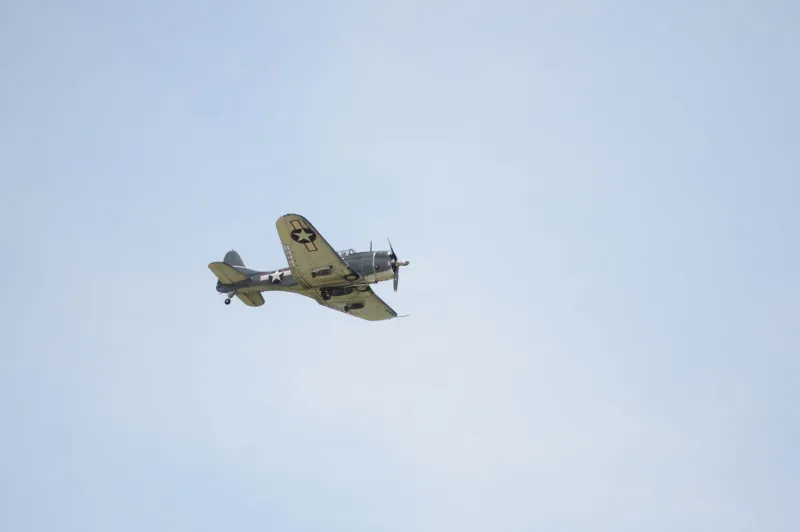
At cockpit level, the American SBD Dauntless crews faced a different clock. Fuel state turned every navigation choice into a gamble. The animated sequences show the difference between a strike group that finds the enemy with enough reserve to attack and one that must turn back. They also show why command confusion was not an abstract staff problem. It was a set of aircraft moving over water with limited time, limited radio discipline, and incomplete information.
Our reconstruction follows the fragmented American air groups rather than inventing a single coordinated sweep. Hornet's torpedo squadron presses an attack alone. Enterprise's squadrons split and search. Yorktown's aircraft add another layer of pressure. The map is not a clean arrow. It is a knot of guesses, sighting reports, and fuel calculations. When Lt. Cmdr. Clarence McClusky makes his decision to continue the search, the animation treats it as a judgment under uncertainty, not as a scripted reveal.
Command Friction, Rendered Visible
Nagumo's dilemma is the center of the animation's middle act. He must decide whether to strike Midway again, prepare for American carriers, or recover and rearm. Each option carries a cost. The animated command view shows how intelligence arrives in pieces and how a commander can make a reasonable decision that becomes unreasonable five minutes later. That is the fog of war made legible: not a smoke machine, but a sequence of incomplete reports and irreversible timetables.
The American side has its own friction. Radio silence, divided air groups, and the sheer size of the search area mean that the dive-bombers do not arrive as a single hammer. They arrive as separate chances. The animation shows why that mattered. A few minutes of separation between squadrons, a cloud bank, or a Japanese turn can change which ships are exposed and which aircraft have the angle to attack.
Cockpit-Level Collapse
The final animated sequence is deliberately restrained. It does not turn the dive into a video game. It shows the approach angle, the release point, the antiaircraft fire, and the sudden vulnerability of carriers packed with fuel and ordnance. The Japanese carriers Akagi, Kaga, and Soryu are hit within a short window. The immediate damage is compounded by secondary explosions and fire. Hiryu survives long enough to launch a counterstrike against Yorktown, which is one reason the battle does not end in a single tidy moment.
Our explainers pause the action to ask what the viewer should notice. Why were the dive-bombers able to approach without being intercepted? What had the torpedo planes drawn away? How did Japanese damage-control practices and American bomb fuzing interact? Animation cannot reproduce heat, fear, or the smell of burning aviation fuel. It can show why three carriers became a single system failure in the space of minutes.
What Eleven Minutes Can and Cannot Explain
The eleven-minute focus is a storytelling device, not a claim that everything was decided by luck. Codebreaking, logistics, carrier doctrine, and the courage of torpedo-plane crews all shaped the conditions for the dive-bomber attack. But the compressed timeline reveals something Hollywood often smooths over: battles are decided by sequences, not by slogans. A commander's delayed turn, a sighting report, a fuel gauge, and a cloud layer can matter as much as a bomb.
PacificWar Animated uses that compression to make the fog of war legible. The point is not to diminish the scale of Midway. The point is to show how a vast fleet action narrowed into a few minutes when the right aircraft arrived at the right place with the right angle and the wrong side's defenses were looking elsewhere.