The Strip of Film That Carried Home: Animating V-Mail's Pacific Route
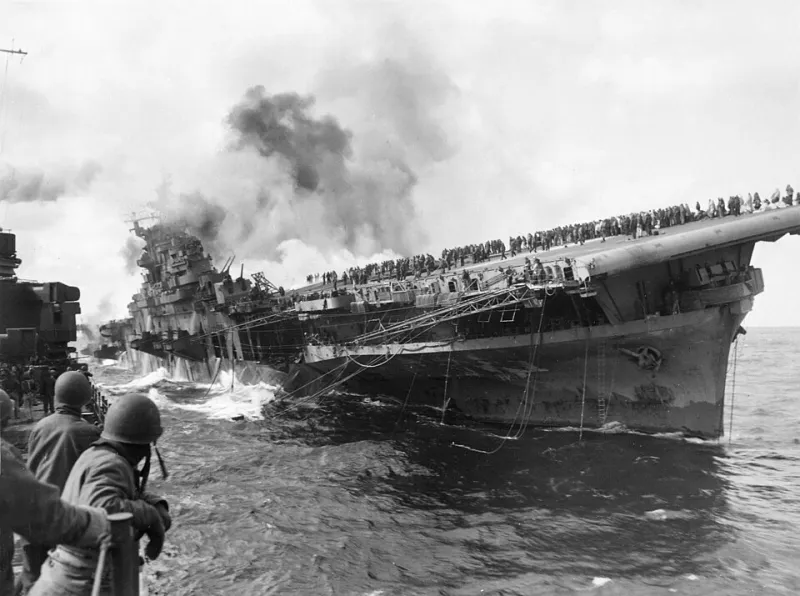
Photo: Photographed by PHC Albert Bullock Uploaded by User:Dna-webmaster to Wikimedia Commons Originally uploaded by User:Stan Shebs to English Wikipedia, Public domain, via Wikimedia Commons
On a kitchen table in Ohio, a mother writes a single page. She fills out a form, addresses it to a son in the Pacific, and drops it into the mailbox. In most retellings, that is where the story ends. For PacificWar Animated, it is where the visual explainer begins. The letter does not fly straight to an island. It enters a system that photographs it, censors it, packs it onto film, ships it across an ocean, and turns it back into paper. V-Mail was not a novelty. It was an industrial answer to a double problem: too much mail for the available cargo space, and too much distance between the home front and the fighting front.
A Letter Becomes a Strip of Film
The War Department and the Post Office called the service V-Mail, for Victory Mail. The name was patriotic; the logic was arithmetic. A single page of ordinary mail is light, but millions of pages become tonnage. Tonnage competes with ammunition, rations, medical supplies, and spare parts. V-Mail promised to shrink the paper without shrinking the connection. The correspondent wrote on a standardized form. The letter was censored, then photographed onto 16mm microfilm. A single reel could carry roughly 1,600 one-page letters. Instead of boxes of envelopes, the postal system moved small cans of film.
An animated sequence can make that transformation legible. The camera pushes in on the handwritten page. The page becomes a negative. The negative becomes a frame. The frame becomes a reel. The reel is loaded into a shipment and disappears into the logistics chain. On screen, the letter is no longer a piece of paper. It is a strip of film, but it still carries a voice. That is the visual tension the explainer should hold: the system is mechanical, but the cargo is intimate.
Censorship Before Compression
It is tempting to tell the V-Mail story as a triumph of technology. The more important point is that technology did not replace censorship. It accelerated it. Before a letter was photographed, it passed through a censor. The censor removed locations, unit details, ship movements, and anything else that could help the enemy. Only then did the letter become microfilm. The sequence matters. V-Mail did not allow a letter to slip around security. It made the security process part of the production line.
For animation, this is a chance to show two kinds of reduction. First, a human hand strikes out a sentence. Then a camera reduces the page to a frame. The first reduction is about secrecy. The second is about space. The article can explain both without treating the censor as a cartoon villain. Most censorship was routine, and many correspondents understood the bargain. They wanted the letter to arrive. They accepted that it would arrive edited.
The Pacific Reader
The film traveled by the fastest available route, often by air and sometimes by sea, depending on the theater and the moment. At the receiving end, the film was developed and the frames were enlarged into small prints. The print was not beautiful. It was small, sometimes faint, and often read under poor light. But it was paper again. A sailor on a picket station or a soldier on an island could hold a page that had been a kitchen table a few weeks earlier.
Here the animated reconstruction should slow down. Show the reader's hands. Show the print. Show the fold. Show the reader looking up from the page toward the water or the jungle. The point is not that V-Mail was as good as a long letter. The point is that it was a practical compromise that kept a line open. The system had limits, and service members noticed them. Small print and cramped format could make a letter feel remote. But remote was better than silent.
What Animation Can Show That a Photograph Cannot
A still photograph can show a V-Mail form or a microfilm reader. It cannot easily show the chain. Animation can. A cutaway can follow a single letter through a postal sorting room, a censorship desk, a camera station, a loading dock, and a Pacific mail call. A map can trace the film's route without pretending that every letter took the same path. A timeline can show why the system mattered most when shipping was tight and when families were desperate for news.
The explainer should avoid the temptation to make the process look too clean. Real mail systems are full of bottlenecks, damaged shipments, and delays. V-Mail reduced bulk, but it did not abolish friction. The animated sequence can show a reel waiting, a printer jammed, a delivery delayed. That honesty makes the final delivery feel earned rather than automatic.
Morale Measured in Ounces
V-Mail is usually described as a mail service. It was also a morale program. The home front could not send the war away, but it could send a page. The service member could not come home, but he could receive a piece of home in a format small enough to fit the cargo ladder. The phrase one ounce of home is not just a sentimental slogan. It describes a tradeoff: fewer pounds in the hold, more messages in the hands of the people who needed them.
For PacificWar Animated, the article's final image should be simple. A reel becomes a print. A print becomes a letter. A letter becomes a face. The camera pulls back from the reader to the island, then to the ocean, then to the map. The system was vast. The page was small. V-Mail worked because it never forgot that the small page was the reason for the vast system.