The Word Was ‘Mutiny’: Port Chicago and the Fifty Sailors Who Refused the Same Risk Again
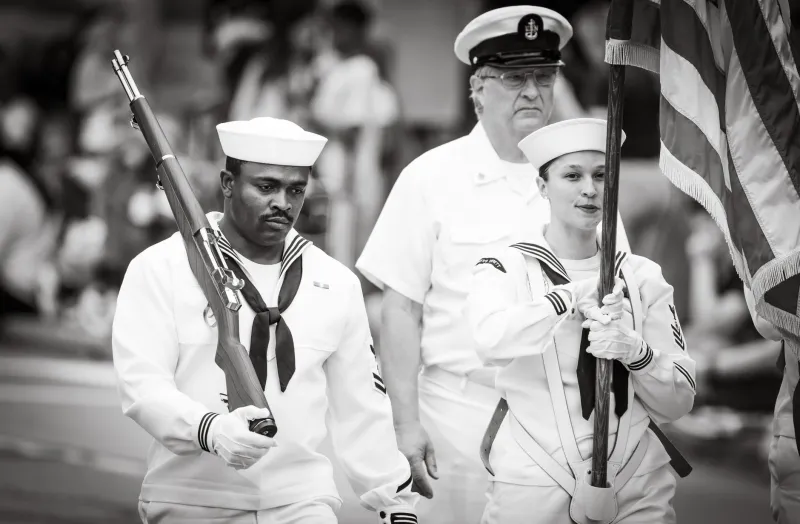
The Port Chicago story is usually told in two words: disaster and mutiny. The first is accurate. The second is a legal label that has done more to obscure the past than to explain it. In July 1944, an explosion at a California naval magazine killed more than 300 sailors and exposed the segregated, dangerous work of loading Pacific-bound munitions. Fifty Black sailors then refused to return to the same conditions. They were charged with mutiny. An animated reconstruction can show the blast, the chain of command, and the trial—but its most important job may be to show why the word “mutiny” was always a contested frame.
The Magazine by the Bay
Port Chicago Naval Magazine sat on the Sacramento–San Joaquin River Delta, east of San Francisco. It was a transfer point for munitions bound for the Pacific. The work was dangerous by design: railroad cars arrived loaded with bombs, shells, and powder; ships waited at the pier; men moved the cargo by hand and by winch. The enlisted men who did most of this labor were Black. Their officers were white. The Navy was segregated, and the assignment reflected the broader assumption that Black sailors could be used for hazardous loading work but not for the full range of naval roles.
Most of the men had received little formal training in ordnance handling. They learned on the job, under pressure, with live munitions. That context matters because it turns a sudden explosion into something more than an accident. It becomes a question of who was asked to bear the risk and who controlled the conditions.
The Blast as an Animation Problem
On the night of 17 July 1944, two ships—the SS E.A. Bryan and the SS Quinault Victory—were at the pier. At about 10:18 p.m., the Bryan exploded. The blast was enormous, visible and audible across the bay area. The shockwave destroyed the pier, damaged the second ship, and killed or injured hundreds of men. More than 300 died; many of the dead were Black enlisted sailors. The exact sequence is difficult to reconstruct because the explosion destroyed much of the evidence and killed many witnesses.
Animation can help by showing scale and sequence: the ships, the pier, the rail cars, the barracks, the blast radius, and the second-order effects. But it should not turn the explosion into spectacle. The point is not the fireball. The point is the proximity of men to munitions they had been ordered to handle, and the way a segregated command structure placed them there.
The Order and the Refusal
After the explosion, survivors were ordered to resume loading munitions. The order was not abstract. It came to men who had just seen their shipmates killed, who had no assurance that safety procedures had changed, and who were still being asked to perform the same work under the same command. Fifty sailors refused. They did not seize a ship. They did not call for the overthrow of authority. They refused a work order until the danger was addressed.
That distinction is central. The Navy charged them with mutiny, a crime that implies a revolt against lawful authority. The prosecution’s case rested on the refusal to obey, but the context was a workplace catastrophe and a segregated system that had already placed these men in harm’s way. The trial became a civil-rights flashpoint because it exposed how easily “discipline” could be used to punish protest against unsafe conditions.
Why ‘Mutiny’ Is the Wrong Frame
The word “mutiny” carries a specific historical weight: it evokes armed resistance, conspiracy, and the breakdown of command. The Port Chicago Fifty did not fit that picture. They were not attempting to take control of the base. They were testing whether a command could order men back into a danger it had not made safe. The Navy’s own subsequent reforms—changes to loading procedures, training, and supervision—suggest that the concerns were not imaginary.
The trial convicted the men and imposed harsh sentences, including years of confinement and dishonorable discharges. The NAACP and Thurgood Marshall took up the case. The convictions were later set aside or reduced, and the men were released. In 2024, the Navy exonerated the Port Chicago 50, a formal recognition that the original verdicts were unjust. That exoneration does not erase the trial. It confirms that the label “mutiny” was always a weapon of its own.
What the Animation Should Show
A responsible animation should move between three scales. First, the pier: the physical layout of ships, rail cars, and loading equipment. Second, the command chain: who ordered what, who was responsible for training, and who controlled the conditions. Third, the courtroom: the charge, the defense, and the racial logic that made the refusal legible as insubordination rather than protest.
The human stakes are not only in the explosion. They are in the moment after it, when fifty men had to decide whether to go back to work. The animation should make that decision understandable without making it simple.
The Fifty and the Record
Port Chicago is often remembered as a disaster that became a mutiny trial. The better framing is a disaster that exposed a segregated system, and a refusal that exposed the limits of the word “mutiny.” For PacificWar Animated, the task is to animate both the blast and the argument—to show how a California pier became a Pacific War home-front battlefield, and how fifty sailors forced the Navy to defend not just its orders but its language.