Coral, Compressors, and Concrete: The Case for the Seabees as the Pacific War's Decisive Weapon
Carrier battles receive the running time. That is understandable: they are dramatic, they are photographable, and they compress months of attrition into a handful of decisive hours. But there is a version of the Pacific War that cannot be told through flight decks, and it deserves more attention than it usually gets. Our argument here is straightforward. The island campaigns were won by whoever could put a functioning airfield on difficult ground fastest, and the men who did that work — the Naval Construction Battalions — shaped strategy as much as any admiral afloat.
The Myth Worth Examining
The popular shorthand runs like this: the carrier displaced the battleship, sea power decided the theater, and the island landings were the necessary follow-through. None of that is false. It is simply incomplete. An island is not an asset because it has been captured. It is an asset when it has a strip that can take land-based aircraft, fuel to keep them flying, berths to repair what breaks, and a supply chain that reaches it on schedule. Capturing ground and converting ground are two different problems, and the second one is engineering.
The Men Who Were Too Old to Draft
The Seabees were authorized in early 1942, and their recruiting profile was unusual for a wartime formation. Rather than taking the youngest available men, the Navy recruited by trade: carpenters, welders, equipment operators, electricians, and cement finishers, many of them in their thirties and forties. Their motto, usually rendered as We Build, We Fight, was not decorative. Construction crews in the Pacific landed with assault waves, worked under fire, and took casualties doing it. Roughly a quarter of a million men served in the battalions over the course of the war, and well over a thousand were killed, with many thousands more wounded.
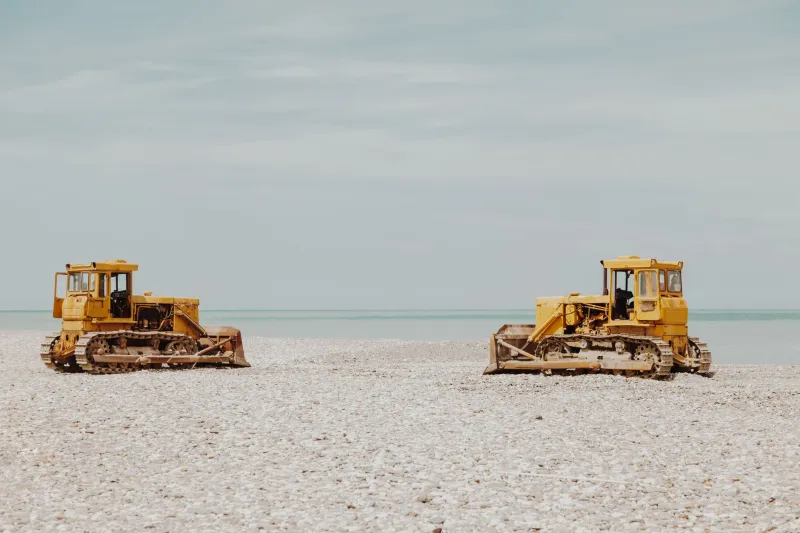
Our animated sequences deliberately show them as a formation of cranes, dozers, and compressor rigs rather than as riflemen, because that is what they looked like on the beach. It is also the honest image: the equipment was the unit's identity.
Coral: The Material That Made the Pacific Buildable
Islands in the Central Pacific offered almost none of what modern construction assumes. No rail network, no cement plants, no aggregate yards, no sawmills turning out dimensional lumber. What they offered was coral, and coral turned out to be enough. Quarried on site, crushed, wetted, and compacted, it produced surfaces that could carry heavy bombers. Seabee crews improvised crushing plants, salvaged steel, and poured and cut and graded their way through objectives that prewar planners had considered marginal.
The animation challenge here is that grading is visually dull and strategically enormous. We solve it by keeping the camera at blade level and letting the runway widen underneath the audience, then cutting to an overhead chart that shows what that surface changed: aircraft range, patrol coverage, the next objective within reach.
The Runway as the Real Prize
At Tarawa, the objective was not the beach. It was the airfield on Betio, and both sides knew it. Assault troops took terrible casualties crossing a reef, and construction crews went to work on a strip that had been wrecked by bombardment and fighting. The same pattern repeats across the theater: take the island, reopen the strip, use the strip, move to the next island. Kwajalein, Saipan, Guam, and Peleliu all fit the template in different proportions. The schedule was set less by how long a battle lasted than by how long repairs took afterward.
Tinian: The Argument Poured in Concrete
If one island settles the case, it is Tinian. North Field grew into a complex of long runways on ground that had been cane fields, and it became the largest airfield installation of the war. The bombers that ended the conflict in August 1945 lifted off from that coral and concrete. Nothing about that outcome was inevitable from the shape of the island. It was the product of survey work, earthmoving, drainage, and thousands of men working shifts around the clock, several thousand miles from the nearest American factory.
Building Under Fire
At Iwo Jima and Okinawa, construction crews repaired strips while under mortar and artillery fire, sometimes within hours of a landing. This is where the argument becomes uncomfortable for the pure combat-power school. A runway that is operational in ten days instead of forty changes the operational timetable, the reach of land-based air cover, and the casualty figures at the next objective. Engineering speed is not a supporting function of strategy. It is a variable inside strategy.
The Fair Counterargument
Seabees could not take an island, and they never claimed otherwise. Marines and soldiers decided who held the ground, and naval gunfire and carrier aviation made the landings possible. Any account that diminishes combat arms to elevate engineers is simply trading one distortion for another. Nor was construction work evenly distributed or evenly recognized; Black Seabees served in segregated battalions and their contribution belongs in this ledger as squarely as anyone else's.
Our claim is narrower and, we think, sturdier: between two opponents with comparable combat power, the one who converts captured ground into usable bases fastest sets the tempo for everything that follows. In the Pacific, that meant the bulldozer was not a support vehicle. It was a weapon of the campaign.
Why We Keep Animating This Argument
Maps make island campaigns look like a sequence of dots acquired in order. Our models try to show the other layer: the strip, the fuel farm, the dispensary, the pontoon causeway, the repair dock, each one built on schedule or behind it. When viewers watch a runway extend across a Pacific island in a matter of seconds, the point lands without a lecture. Attrition and industry decided the war, and the men with the compressors were doing both.