The Canteen, the Codebook, and the Blade: Seven Artifacts That Explain the Pacific War
A war fought across a third of the planet resists scale. Figures help — thousands of ships, tens of thousands of aircraft, millions of men under arms — but figures are abstractions, and abstraction is where attention drifts. Objects work differently. A canteen fits in a palm. A codebook is the size of a stacked sandwich. For PacificWar Animated, the production method is consistent: open an episode on a single object at tabletop scale, animate its mechanics, and only then pull the camera back to an ocean map. These seven artifacts are the ones we keep returning to, because each one opens onto a theme that shaped the campaign.
Why Small Objects Carry the Argument
The Pacific War is usually told through its largest machines, and that is partly correct — the fast carrier task force genuinely reordered naval warfare. But the war was also decided by items that cost a few dollars and were issued by the million, and those items are easier for a modern audience to hold in mind. Each entry below follows the same structure: an animated close-up of the object, then the human and strategic context that surrounds it.
1. The Canteen — Water as a Logistics Problem
Begin with the most boring object in the inventory. A serviceman's canteen held roughly a quart, and in the tropics a quart was a rounding error. Troops working in equatorial heat needed gallons a day, not quarts, and the difference had to be manufactured, shipped, purified, and delivered to beaches that had no plumbing. Animating a canteen lets us show a supply chain in miniature: the distillation and purification units working behind the lines, the tankers riding at anchor offshore, the cans moved inland by hand and by truck. Water discipline was not a footnote to Pacific operations. It was one reason some beachheads could be held and others could not.
2. The Codebook — A Volume That Could Move a Fleet
A codebook is a physical thing with a serial number, and that is precisely the point. Fleets that believe their codes are secure plan boldly. When a code is compromised, everything downstream — patrol schedules, convoy routes, the timing of an operation — must be rewritten, and the cost is measured in weeks. Our animated sequences of a code room are deliberately unglamorous: chalkboards, filing cabinets, and very patient people. Ship a book across an ocean in a locked pouch and you are trusting one courier with the timing of a campaign. That is what secrecy looked like in practice, and it is why the loss of a single volume could matter more than the loss of a destroyer.
3. The Mae West — Twenty Seconds of Buoyancy
The inflatable life vest issued to aircrews took its nickname from a well-known film star's silhouette, and the humor was a coping mechanism. Pacific air combat was flown over water, which meant that a damaged aircraft frequently ended not in a crash but in a ditching. A crew had minutes in the water. Whether they were recovered came down to dye markers, small radios, and the flying boats and submarines assigned to rescue duty. The vest is where survival intersects with search-and-rescue doctrine, and our animation treats that intersection as the story: the fraction of an hour that separated a rescued crew from a missing one.
4. The Bulldozer Blade — Coral as a Construction Material
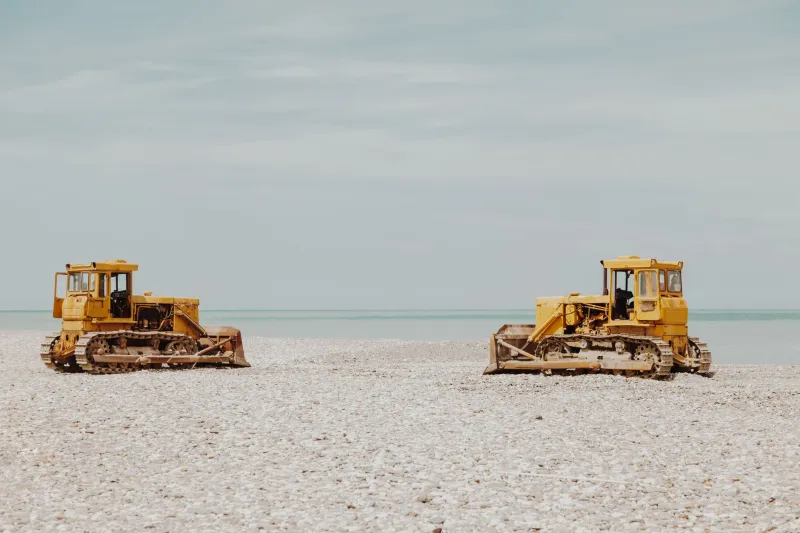
The blade is the object that turns a natural feature into a base. Pacific islands rarely offered the aggregate, timber, and paving materials that modern airfields required, but they offered coral, which could be quarried nearby, crushed, wetted, and compacted into a surface that held heavy bombers. Watching a blade work is watching strategy being built. It is also the seed of a longer argument we make elsewhere on this site: that engineering speed, more than combat power alone, determined which islands mattered.
5. The Spam Can — Industrial Reach in a Tin
More than one hundred million pounds of canned meat went overseas during the war, and troops complained about it with real feeling while depending on it entirely. The tin is a logistics story disguised as a punchline. It points to refrigerated cargo ships, floating depots, and the fleet train that let carrier groups remain at sea for weeks rather than days. It also points to the peculiar luxuries of industrial war — the barges that churned out ice cream by the gallon for crews working in tropical heat. Industrial scale is usually described in tonnage. A can makes that tonnage edible.
6. The Mosquito Net — The Enemy That Was Not Shooting
In several South Pacific commands, hospital admissions from malaria and dengue outnumbered battle injuries, sometimes by a wide margin. The net, treated with repellent and tucked with discipline, was as consequential as any weapon on the island. Our animation of a net at dusk, with the shape of a man beneath it, communicates more than a chart of admission rates does. Attrition is not only inflicted by an opponent. It is also managed, badly or well, by small habits and small gear.
7. The V-Mail Slip — The Home Front at Microfilm Scale
The V-mail system photographed letters onto microfilm, shipped the film, and reprinted the pages near the recipient, reducing tens of thousands of pounds of mail to a sack or two. Air transport capacity was zero-sum: every pound of letters was a pound not carrying ammunition, medical supplies, or aircraft parts. The microfilm slip is where the home front enters the same ledger as the fleet, and it is a rare artifact that carries both morale and tonnage in one frame.
What the Seven Prove Together
None of these objects fired a shot, and that is the argument. The Pacific War was an industrial contest fought at close range by individuals who mostly worried about water, mail, insects, and whether the strip would be ready. For our animation team the practical lesson is simple: start with what a person could carry, and the strategic picture arrives on its own.