The Barometer and the Admiral: An Animated Autopsy of Task Force 38's December Storm
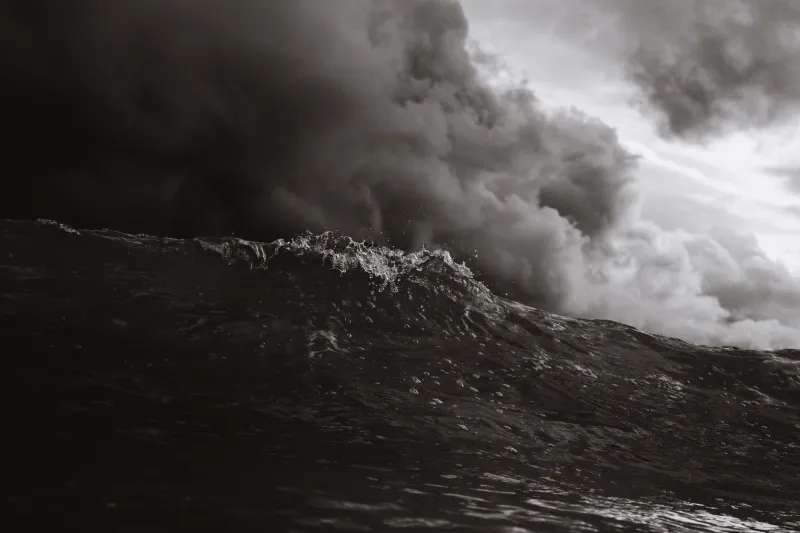
On 18 December 1944, the Pacific Ocean did what navies have always feared it could do: it swallowed ships that had survived enemy fire. Admiral William F. Halsey's Third Fleet, then operating as Task Force 38, was caught east of the Philippines by a violent tropical cyclone later known as Cobra. When the seas subsided, three U.S. destroyers — USS Hull, USS Spence, and USS Monaghan — had capsized, and roughly 790 sailors were dead. The loss was not the result of a single failed order. It was the product of a chain of assumptions, schedules, and incomplete forecasts that an animated reconstruction can make visible in ways a static map cannot.
A Storm With a Paper Trail
Typhoon Cobra is unusually well suited to animation because it left behind a dense paper trail. Weather reports, fleet dispatches, fueling records, and after-action testimony all describe the same event from different angles. Our animated autopsy layers those sources rather than replacing them. Track lines show the fleet's movement hour by hour. Shaded bands show the estimated storm path and the widening cone of forecast uncertainty. Ship icons show not only where vessels were but what condition they were in — fuel state, ballast, damage, and station in formation.
That last layer matters. The three lost destroyers were not simply in the wrong place. They were low on fuel, and their stability had been affected by the demands of sustained operations. In heavy seas, those details become decisive. Animation allows the viewer to see the fleet as a system of ships with different margins, not as identical counters on a board.
What the Moving Map Reveals
The first thing a time-stamped reconstruction shows is that the storm was not a total surprise in the abstract. Pacific weather patterns gave forecasters reason to expect dangerous conditions. What remained uncertain was the exact track, timing, and intensity. In 1944, there were no weather satellites, no Doppler radar, and no reliable real-time storm fixes across the open Pacific. Forecasters worked from ship reports, atmospheric pressure readings, and experience. Their product was a probability, not a promise.
The second thing the animation shows is the compression of time. Task Force 38 was operating under pressure to support the Luzon campaign. Fueling at sea was a recurring necessity, and the fleet's position was shaped by the need to remain ready for combat operations. When weather warnings arrived, they competed with operational imperatives. A static map can show the storm and the fleet in the same frame. An animated map shows how late the warning arrived relative to the fleet's fueling schedule and how difficult it would have been to reverse course without disrupting the larger plan.
The Decision Chain, Not a Single Villain
It is tempting to turn the typhoon into a simple story of one admiral's arrogance. That is neither historically accurate nor analytically useful. The court of inquiry that followed criticized Halsey and his staff, and the episode damaged his reputation. But the record also shows a command system under strain, with conflicting weather advice, imperfect communications, and a culture that rewarded offensive persistence.
An animated decision tree helps here. Each node represents a choice: whether to fuel, when to fuel, which weather report to weight, whether to divert, and how much risk to accept. The animation does not absolve anyone. It shows how a reasonable decision at one node can become a dangerous decision when combined with others. The destroyers were lost because the fleet's geometry, fuel needs, and weather uncertainty intersected. The visualization makes that intersection legible.
Why This Autopsy Matters
For viewers raised on satellite loops and smartphone forecasts, the December 1944 storm can look like a failure of common sense. The animation corrects that impression. It shows the limits of mid-century ocean forecasting and the difficulty of commanding dozens of ships in bad weather. It also shows why navies study losses that do not involve contact with the enemy. The sea is an adversary with no headquarters and no negotiable terms.
The final frames of the reconstruction return to the rescue effort. USS Tabberer and other ships fought heavy seas to recover survivors. Those images are not a redemption arc. They are part of the same autopsy. The typhoon killed hundreds of Americans and sank three destroyers, but the response also revealed seamanship and courage under extreme conditions. Animation can hold both truths at once: the failure that put ships in harm's way and the professionalism that saved those who could be saved.