The Fortress Left Behind: Animating Rabaul as a Prison Rather Than a Prize
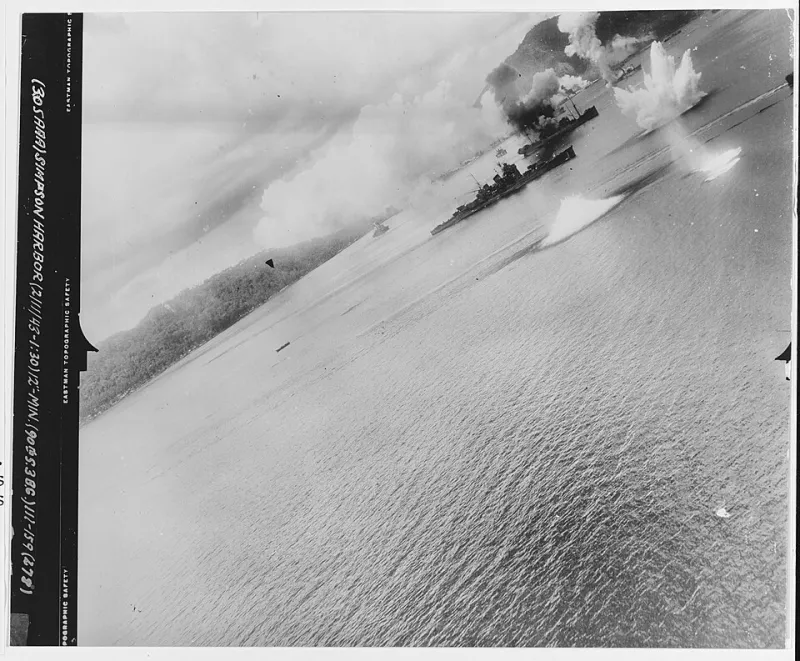
Photo: Presumed official USN or IJN photographer, Public domain, via Wikimedia Commons
A Harbor Worth More Than a Battle
Rabaul occupies a peculiar place in the Pacific War imagination. It was one of Japan's most important bases in the South Pacific, a sheltered anchorage at the northern tip of New Britain surrounded by airfields and defended by tens of thousands of troops. Yet the Allies never landed there in force. The fortress that seemed to demand a climactic assault was instead left to wither behind a screen of airpower, interdiction, and geography.
For PacificWar Animated, Rabaul is an ideal subject because the story is not a single battle but a system of pressure. Animated maps can show the base not as a point on a map but as a node in a network that Allied planners gradually severed. Sortie timelines can turn months of repeated raids into a legible pattern. The result is an autopsy of a campaign that succeeded by refusing the most obvious move.
Cartwheel's Uncomfortable Logic
The Allied decision to bypass Rabaul emerged from Operation Cartwheel, the broad 1943 plan to isolate the Japanese stronghold rather than capture it. The logic was uncomfortable but clear. Rabaul's defenses were formidable, its garrison large, and the cost of a direct assault likely to be severe. At the same time, the base depended on shipping, fuel, and aircraft that had to come from elsewhere. If those links could be cut, the fortress would remain dangerous but increasingly irrelevant.
This was not a passive strategy. It required Allied air forces to attack Rabaul repeatedly, to keep its airfields under pressure, and to strike the convoys that sustained its garrison. It also required the seizure of supporting positions elsewhere in the Solomons and along New Guinea's coast, positions that gave Allied aircraft the range and bases needed to make the isolation real. The animation challenge is to make that indirect geometry visible: not one arrow pointing at Rabaul, but many arrows closing around it.
Animation as an Autopsy of Isolation
A conventional map of the South Pacific can make Rabaul look like a distant dot. An animated treatment can show why distance mattered. Allied aircraft operating from New Guinea and the Solomons faced long flights, uncertain weather, and narrow margins of fuel. Each raid was not a single event but a chain of decisions: which airfield to hit, which approach to use, how to coordinate fighters and bombers, and how to measure success when the target was not a ship or a trench but the enemy's ability to keep fighting.
Sortie timelines are especially useful here. They can reveal the rhythm of the campaign: periods of intense pressure, pauses forced by weather or maintenance, and the cumulative effect of repeated attacks. They can also show the human cost. Aircrew losses were not confined to a single dramatic mission. They accumulated across months of dangerous flights over water and jungle, in aircraft that sometimes returned damaged or did not return at all.
The Air Campaign as a Siege Without Walls
The neutralization of Rabaul was a siege conducted from the air, but it was not a simple bombing campaign. Allied planners sought to suppress the base's offensive power while avoiding the kind of costly ground battle that had marked earlier island operations. That meant repeated strikes against airfields, harbor facilities, and shipping, along with fighter sweeps designed to keep Japanese aircraft from contesting the skies.
Convoy interdiction formed the other half of the pressure. Rabaul's garrison needed food, ammunition, fuel, and replacement aircraft. When those shipments were attacked or forced to turn back, the base's strength eroded even if no Allied soldier set foot on New Britain. The campaign was therefore cumulative rather than decisive. Its success lay in making Rabaul too expensive to use and too isolated to threaten Allied advances elsewhere.
What the Timelines Show
An animated timeline can make a point that prose sometimes obscures: the Allies did not need to destroy every Japanese soldier at Rabaul. They needed to destroy the base's function. By 1944, Rabaul remained a garrison, but it was no longer the pivot of Japanese operations in the South Pacific. Allied forces moved past it toward the Philippines and beyond, leaving the fortress to wait for a war that had already moved on.
That outcome was not inevitable. It depended on aircrew endurance, on logistics, on the capture of intermediate bases, and on the willingness of Allied commanders to accept an indirect approach. The animation can show this as a contest of time and distance. Each raid, each convoy strike, and each new airfield changed the balance. The fortress did not fall in a day. It was slowly subtracted from the war.
The Cost of Not Invading
The bypass strategy saved the Allies from a likely costly assault, but it was not cheap. The air campaign consumed fuel, ordnance, and flight hours. It tied down squadrons that might have been used elsewhere. It exposed aircrews to weather, mechanical failure, and enemy fire over a long period. For the Japanese garrison, the cost was different but equally severe: isolation, dwindling supplies, and the knowledge that the war had passed them by.
For a US audience, Rabaul is a reminder that American military success in the Pacific was not only a matter of landing craft and rifles. It was also a matter of planners choosing which battles not to fight. The animated autopsy makes that choice concrete, showing the fortress on the map and then showing the many smaller actions that turned it into a prison.
Why Rabaul Still Matters
Rabaul is not remembered as a great Allied victory parade. It is remembered as a problem that was solved by patience and pressure. That makes it a useful subject for PacificWar Animated, because the site's purpose is to show the Pacific War as a system of decisions, not only a sequence of battles. The fortress they chose not to storm remains one of the war's most instructive operational choices, and animation is a fitting way to explain why.