Blind Geometry: An Animated Autopsy of Pacific Night-Fighter Intercepts
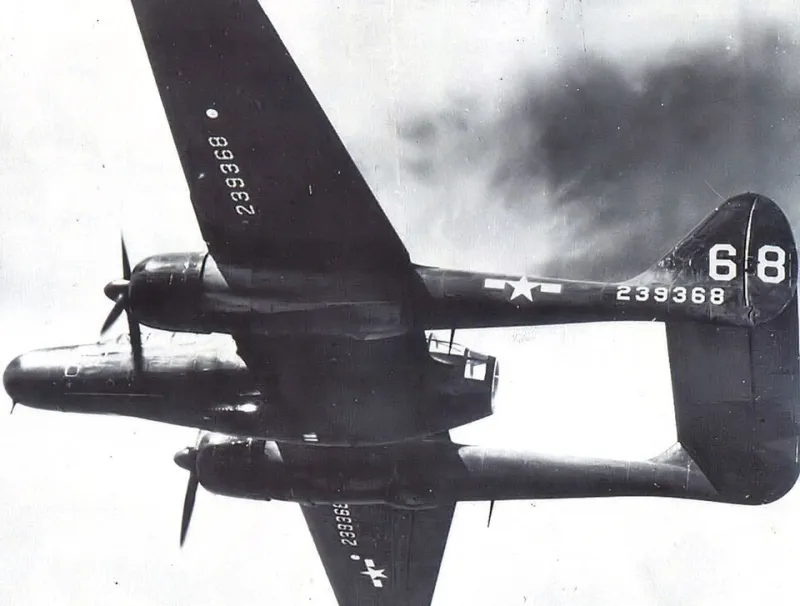
Photo: United States Army Air Forces, Public domain, via Wikimedia Commons
Darkness is often treated as a pause in air combat. In the Pacific, it was a different map. A bomber that could not be seen by the naked eye still cast a radar return, and a fighter that could not safely fly formation in daylight conditions could still be steered toward an unseen target by a controller on an island hundreds of miles from the action. The night war was not a blurred version of the day war. It was a separate problem in geometry, electronics, and nerve.
For PacificWar Animated, the night-fighter story is especially suited to animated explanation because so much of it happened out of sight. Radar beams, closure rates, identification procedures, and the mental model shared by pilot and radar operator are invisible on a conventional map. Animation can make those layers visible without pretending that the decision was easy.
The Night as a Contested Map
The arrival of purpose-built night fighters in the Pacific did not instantly banish darkness. It changed what darkness meant. Japanese raids, transport runs, and reconnaissance flights had long used night to reduce interception risk. Allied defenders had to answer with a system, not merely an aircraft. That system combined radar pickets, ground-control intercept stations, communications networks, and aircraft capable of finding a target without visual contact until the final moments.
The P-61 Black Widow is the natural visual anchor for that system, but it was not a lone hunter. Its value depended on a chain of information that began with early-warning radar and passed through a controller who had to translate a flickering scope into a course, speed, and altitude instruction. The pilot then had to fly that instruction while the radar operator inside the aircraft refined the approach. The enemy aircraft was the target, but the real battle was against uncertainty.
From Ground to Air: The Vector Chain
An animated intercept diagram can show the vector chain clearly. A ground radar station detects a raid. A controller estimates its course and sends a night fighter toward an intercept point. The fighter does not fly directly at the bomber in a straight line; it flies a course designed to bring the two aircraft together at a predictable place and time. If the controller's estimate is wrong, the fighter may arrive too early, too late, too low, or too far off to complete the intercept.
This is where animation earns its place. A static map can show a line from island to target, but it cannot easily show the shifting cone of radar coverage, the difference between the bomber's track and the fighter's vector, or the shrinking distance in which the crew must transition from ground control to onboard radar. By layering those elements, the viewer can see why a successful night intercept was a collaborative act rather than a solitary duel.
The human tension is equally important. Controllers worked with incomplete information. Radar returns faded. Weather interfered. IFF procedures had to prevent friendly-fire mistakes without slowing an interception to the point of failure. A voice on the radio could sound calm while making a decision that would place another crew in the path of an unseen aircraft.
Inside the Black Widow's Blind Intercept
The Black Widow's crew arrangement made the night war a shared mental exercise. The pilot flew the aircraft and maintained the intercept geometry. The radar operator managed the airborne radar and called out the target's relative position. In the final phase, the pilot might still be unable to see the target, while the radar operator described a return that was growing larger and more urgent. The transition from instrument contact to visual contact was brief and often ambiguous.
Animated reconstructions can slow that final phase down. They can show the radar scope as the operator might have described it, the pilot's control inputs as the aircraft adjusted course, and the outside darkness that refused to reveal the target until the last possible moment. They can also show where the intercept could fail: a target that turned, a radar return that merged with clutter, a closure rate that left too little time for identification.
This is not a story about a wonder weapon. It is a story about a system with seams. The Black Widow was powerful because it gave crews a way to fight at night, but its effectiveness depended on training, maintenance, controller skill, and the discipline to follow procedures when the instinct to improvise was strong.
Animation as an Instrument of Judgment
PacificWar Animated's approach to this subject should resist the temptation to make the night fighter look omniscient. Radar did not grant perfect vision. It granted a partial picture that had to be interpreted. An animated diagram can show the difference between what the controller knew, what the radar operator saw, and what the pilot could confirm. Those three pictures rarely matched exactly.
That mismatch is the drama. A viewer can watch a bomber's track cross a radar horizon and see the fighter's vector bend toward an intercept point. Then the onboard radar takes over, and the scale tightens. The final seconds can be shown not as a clean lock but as a sequence of calls, corrections, and strained eyes. The animation makes the invisible visible, but it should also make the uncertainty visible.
What the Diagrams Can and Cannot Show
No animated reconstruction can fully recover a night intercept. Radar performance varied with equipment, maintenance, operator experience, and atmospheric conditions. Crew accounts were written after the fact and shaped by memory. The diagrams can clarify geometry and sequence, but they cannot replace the documentary record or pretend to know every thought in a darkened cockpit.
That limitation is worth stating plainly. The value of the animation is explanatory, not evidentiary. It helps a general audience understand why night fighting required a network, why ground control mattered, and why a crew's success was often the product of many small correct decisions made under poor visibility.
Why the Night War Still Matters
The Pacific War is often visualized in daylight: carrier flight decks, beachheads, and bomber formations. The night war adds a quieter but no less demanding dimension. It shows how technology changes combat only when it is embedded in training, organization, and human judgment. The Black Widow crews and the controllers who guided them did not eliminate darkness. They made it contested.
For an animated-history project, that is the useful lesson. The night sky over the Pacific was not empty. It was full of vectors, voices, and guesses. Animation can help viewers see the geometry, but the enduring story is about people who had to act before they could see.