Pumps, Patches, and Patience: Animating How Pearl Harbor Rebuilt Its Battle Line
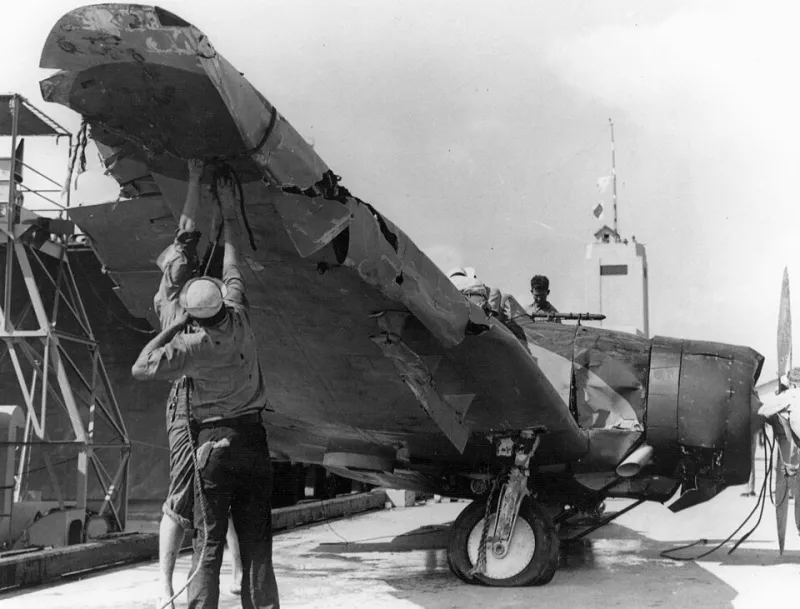
Photo: USN, Public domain, via Wikimedia Commons
The attack on Pearl Harbor is usually told in minutes: the torpedoes, the bombs, the smoke, the list of losses. But for the U.S. Navy, the more consequential story began after the smoke cleared. The salvage campaign that followed was not a single dramatic episode. It was a grinding, month-by-month industrial contest fought in oily water, flooded compartments, and crowded drydocks. For PacificWar Animated, that contest is a natural subject for visualization, because it is a story of hidden systems: pumps, patches, divers, welders, and the slow arithmetic of repair.
A Second Battle Begins
On 7 December 1941, the Japanese raid left several battleships sunk or badly damaged in Pearl Harbor. Some were upright but flooded. Others had settled into the mud. USS Oklahoma had capsized. USS Arizona was a total loss and remains a memorial. USS Nevada had been beached to prevent it from blocking the channel. USS California, USS West Virginia, and others were in various states of wreckage.
The immediate military problem was not simply replacing lost ships. It was restoring the harbor itself as a functioning base while recovering as much combat power as possible. That meant salvage work had to begin before the last fires were out. It also meant the attack’s meaning could not be measured only by what was destroyed on 7 December. It had to be measured by what could be returned to service later.
An animated treatment makes this clear in a way a static map cannot. A harbor map can show where each ship lay. A cutaway can show why one ship was easier to raise than another. A timeline can show that the salvage race was not a montage of heroic diving, but a sequence of engineering decisions with delays, setbacks, and revisions.
The Harbor as a Workshop
Pearl Harbor became a repair factory under pressure. Divers worked in near-zero visibility, feeling their way through flooded compartments. They sealed leaks, patched hull openings, and prepared ships for pumping. Welders and riggers built cofferdams and temporary structures. Pumping crews fought to remove water faster than it could return. Drydocks became the next bottleneck once a ship was afloat again.
The animation concept here is not to glamorize the work, but to expose its logic. Cutaways can show a torpedo hole below the waterline, the patch being fitted over it, and the water being pumped out compartment by compartment. Harbor maps can show the sequence of tow movements and the limited drydock space. Month-by-month timelines can show how a ship that looked hopeless in December became a repair candidate in January, a drydock occupant in the spring, and a returning unit later in the war.
That is the editorial value of animation: it can make visible the unglamorous machinery of recovery. The salvage campaign was not won by a single invention. It was won by the accumulation of many small fixes, each one dependent on the last.
Month by Month: What the Animation Shows
The precise sequence of each ship’s recovery varied, but the broad pattern can be animated as a campaign rather than a single event. In the first weeks, the work focused on assessment, firefighting, and preventing further damage. Divers surveyed hulls. Crews removed ammunition and stores where possible. Plans were drafted for patching and pumping.
In the following months, the harbor shifted from emergency response to industrial recovery. Ships were patched, pumped, and moved. Some were towed to drydocks on the West Coast for major repairs. Others were repaired locally. USS Nevada was eventually salvaged and repaired, returning to service. USS California and USS West Virginia were raised and rebuilt, though the work took time. USS West Virginia, in particular, became a symbol of the salvage effort’s payoff when it returned to action later in the war.
The month-by-month animation should resist the temptation to make the process look tidy. The historical record includes failed pumps, bad weather, difficult diving conditions, and the constant competition for skilled labor and drydock capacity. Those constraints are the story. They explain why the salvage race mattered as much as the raid: it tested whether the U.S. Navy could convert wreckage into readiness.
Why the Salvage Race Mattered
The salvage campaign mattered for three reasons. First, it recovered ships that could still fight. The U.S. Navy needed every hull it could get in the Pacific, and the repaired battleships eventually supported later operations, including convoy escort, bombardment, and surface action. Second, it preserved industrial confidence. The attack had been a shock, but the repair effort demonstrated that the fleet’s supporting system could absorb damage and keep working. Third, it turned Pearl Harbor into a laboratory for underwater repair, damage control, and salvage technique.
For a modern audience, the animation can connect those points without turning the story into a simple tale of American ingenuity. The salvage effort was impressive, but it was also dangerous, slow, and improvised. It depended on divers who could not see, crews who worked in contaminated water, and planners who had to make hard choices about which ships were worth saving.
What the Cutaways Reveal
The most useful animated cutaways are not the ones that show a ship as a hero. They are the ones that show a ship as a system. A battleship is a set of compartments, pipes, valves, shafts, and bulkheads. When it floods, the problem is not just the hole. It is the network. A cutaway can show how water moved through that network, why counterflooding mattered, and why patching one opening might not be enough.
That approach fits the PacificWar Animated editorial concept: the Pacific War, drawn from history. The salvage of Pearl Harbor is not merely an epilogue to the attack. It is a battle autopsy of the harbor itself, conducted month by month, with pumps and patches instead of guns.