Borrowed Decks, Mounted Guns: Animating the Armed Guard’s Pacific War
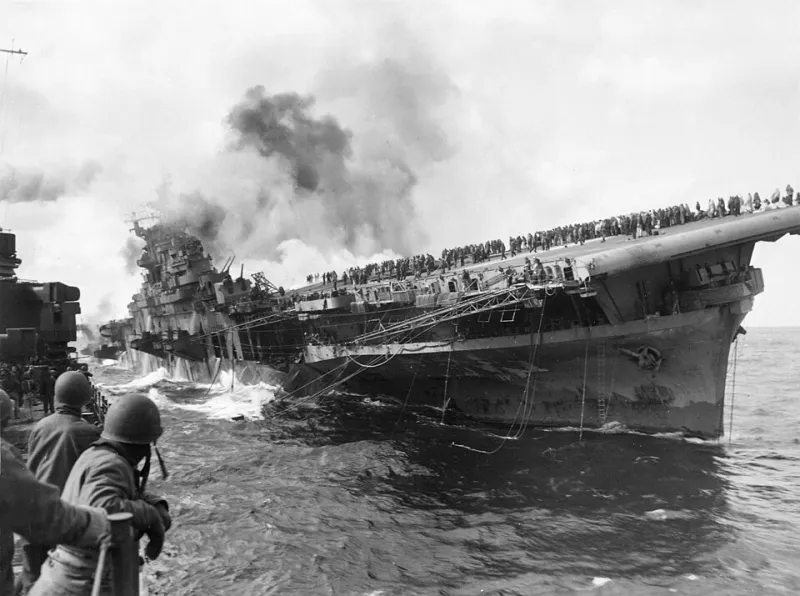
Photo: Photographed by PHC Albert Bullock Uploaded by User:Dna-webmaster to Wikimedia Commons Originally uploaded by User:Stan Shebs to English Wikipedia, Public domain, via Wikimedia Commons
A freighter is not a warship. It has no armored belt, no main battery, no designed damage-control scheme for battle. Yet in the Pacific War, thousands of American cargo ships and tankers carried Navy gun crews whose job was to make the vessel something more than a target. These were the men of the Naval Armed Guard: small, often isolated detachments assigned to merchant hulls, tasked with manning guns, maintaining communications, and keeping a floating supply line alive when Japanese submarines, aircraft, and kamikazes came within range.
For PacificWar Animated, the Armed Guard is a natural subject for an animated autopsy. The force is difficult to see in traditional battle histories because it fought aboard ships that historians usually describe in terms of cargo tonnage, not combat geometry. Deck-plan animation can change that. It can show where the guns sat, how a cargo boom or deckhouse blocked a field of fire, how ammunition moved under combat conditions, and how a crew of roughly two dozen sailors occupied a vessel designed for civilian commerce.
A Force Built Around a Gun, Not a Hull
The Armed Guard was a Navy organization serving aboard non-Navy ships. Its sailors were not the merchant crew, though they lived and fought alongside them. Their assignment was narrow and practical: operate defensive guns, handle signaling and communications, and provide a disciplined military presence on vessels that might otherwise have no trained gunners at all. In the Atlantic, that meant confronting U-boats. In the Pacific, it meant a more varied war: submarine attacks on convoy routes, air raids near beachheads, and, by the war’s final year, the possibility of a kamikaze plunging toward a transport or tanker.
The visual story begins with the deck plan. A Liberty ship or T-2 tanker had limited space for weapons. Gun tubs were added where they could be fitted. A 3-inch or 5-inch gun might sit aft or forward, with 20mm Oerlikons and later 40mm Bofors mounts placed to cover arcs that the main gun could not. Each placement involved compromise. A gun with a clear arc might expose its crew. A protected mount might have a blind spot. Animation can make those compromises legible in a way a photograph cannot.
Animating the Convoy Problem
The Pacific convoy map is another essential layer. Armed Guard crews did not fight in isolation. They were part of a convoy system that moved fuel, ammunition, food, aircraft parts, and troops across enormous distances. A single tanker might carry the fuel that kept an invasion fleet moving. A cargo ship might hold the spare engines and radar sets that kept a squadron operational. When a submarine attacked, the Armed Guard’s guns were part of a larger defensive problem: escorts, air cover, radar, sonar, and the merchant crews’ own seamanship all mattered.
Animated convoy maps can show the danger zones without turning the story into a simple tally of sinkings. They can show how a torpedo track forced a ship to turn, how a gun crew’s field of fire narrowed as the vessel maneuvered, and how quickly a merchant formation could lose coherence at night or in poor visibility. The Armed Guard’s war was often a war of seconds: a sighting, a bearing, a burst of fire, and then the question of whether the ship was still underway.
When the Cargo Deck Became a Battleship
Veteran accounts frequently return to the same theme: the ship was not built for this. Merchant crews and Armed Guard sailors worked in spaces never intended for combat. Ammunition had to be stored and passed by hand. Gun crews trained on decks crowded with cargo gear. A tanker’s dangerous cargo made every hit a potential catastrophe. The Armed Guard’s combat experience was therefore not a scaled-down version of a destroyer’s war. It was a distinct problem: fighting from a vessel whose survival mattered to the fleet but whose design prioritized cargo.
This is where animation can do more than illustrate. It can dramatize the relationship between a ship’s civilian structure and its military role. A deckhouse becomes cover. A cargo hatch becomes an obstacle. A gun tub becomes a small defended island on a long, exposed deck. The result is not a glamorous image of naval power but a precise one: a supply ship turned into a fighting platform by the people assigned to defend it.
The Last Mile: Kamikaze and the Close Fight
By the war’s final campaigns, the Armed Guard’s Pacific war included the threat of suicide aircraft. A transport or tanker approaching Okinawa or the Philippines could be attacked at close range, with little time for interception. The gun crew’s problem was suddenly three-dimensional: aircraft approaching from multiple bearings, smoke and fire on deck, and the need to keep firing while the ship’s crew fought damage. Animated reconstructions can show how 20mm and 40mm mounts engaged targets that a main gun could not track, and how the geometry of a convoy changed when every ship became a potential target.
These scenes also correct a common misconception. The Armed Guard was not merely a ceremonial detachment or a labor detail. Its sailors trained for gunnery, stood watches, and absorbed casualties. The force was small aboard each ship, but its presence transformed the defensive capacity of the merchant fleet. That transformation is the heart of the story.
Why the Armed Guard Belongs in the Battle Narrative
The Armed Guard is easy to overlook because it does not fit the familiar silhouette of a warship. There is no cruiser’s bridge, no carrier’s flight deck, no destroyer’s torpedo tubes. There is only a freighter, a tanker, or a transport with a few guns and a crew determined to keep it afloat. Yet the Pacific War depended on those ships. The fleet could not fight without fuel, ammunition, and replacements. The Armed Guard helped ensure that the logistics chain was not simply a passive backdrop to battle but a contested space in its own right.
For an animated-history project, that is the value of the subject. Deck plans, convoy routes, and veteran testimony can turn an overlooked assignment into a visible combat narrative. The Armed Guard’s war was not fought from the center of the fleet. It was fought from the decks that kept the fleet moving.