No Fanfare at General Quarters: Animating the Destroyer War the Pacific Could Not Do Without
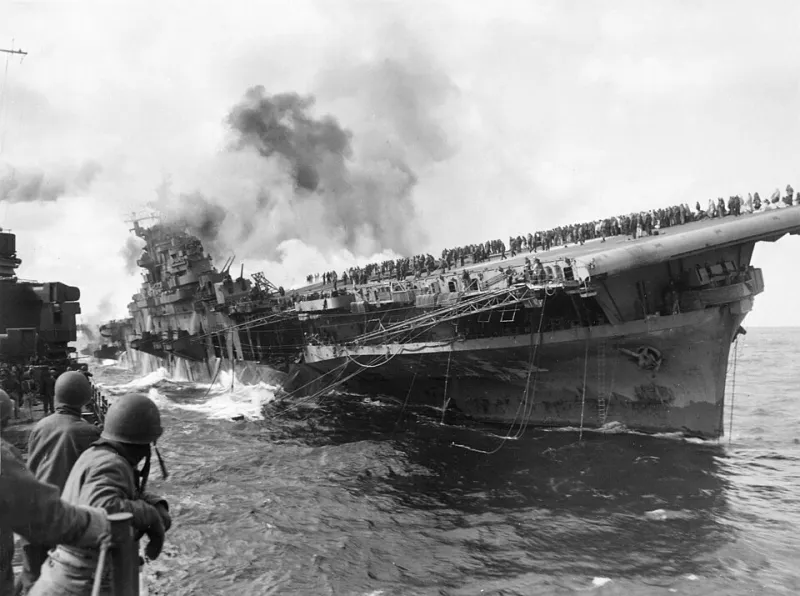
Photo: Photographed by PHC Albert Bullock Uploaded by User:Dna-webmaster to Wikimedia Commons Originally uploaded by User:Stan Shebs to English Wikipedia, Public domain, via Wikimedia Commons
For every carrier launch and every battleship broadside, there was a destroyer somewhere nearby doing work that rarely made the front page. The Pacific War's most consequential naval duty was often not a dramatic fleet engagement but a long, anxious escort run: a screen of lean ships shepherding supply vessels, troopships, and fuelers across water that could turn hostile without warning. PacificWar Animated's latest reconstruction treats that duty as a subject in its own right, following a representative escort run from Pearl Harbor to a forward anchorage and mapping the tedium, the alerts, and the split-second choices that turned ordinary nights into catastrophes.
The Run That Looked Routine
On paper, the assignment was simple. A destroyer would join a convoy screen, maintain station, keep lookouts and sound gear active, and deliver the group to its destination. The orders were ordinary. The sea was not.
The animated sequence begins at Pearl Harbor with the small rituals of departure: lines singled up, engineering plants tested, watches set, and a captain reviewing a screen diagram that looks neat on paper and fragile in practice. Out beyond the harbor, the diagram becomes a living problem. The convoy must zigzag. The destroyer must cover arcs of water it cannot see. Radio silence may be necessary. Rain squalls may hide a submarine or reveal a ship's silhouette at the wrong moment.
This is where animation has an advantage over a single map. It can show the convoy as a moving organism, the destroyer as one of several thin membranes around it, and the ocean as a volume rather than a flat surface. The viewer sees not only where the ships are but also what the crews cannot know.
Tedium as a Tactical Condition
The popular image of the Pacific War favors fire and smoke. The destroyer's war was often quieter: hours of engine vibration, stale coffee, repeated drills, and the low hum of ventilation. That tedium was not an absence of war. It was the baseline condition in which war was fought.
Fatigue matters in an autopsy. A crew that has stood watch after watch is not a machine. Attention narrows. Sound operators strain to distinguish a screw bearing from a false contact. Lookouts scan until the horizon becomes a pattern. A captain must decide whether to investigate a contact or hold the screen. The wrong choice can expose the convoy; the other wrong choice can leave a submarine unmolested.
The animation deliberately lingers on these stretches. It uses repetition, small sounds, and changing light to show how routine duty creates vulnerability. Submarine commanders understood that a convoy's greatest enemy was often not a single perfect attack but the cumulative erosion of alertness.
The Alert That Breaks the Night
Then comes the contact. General quarters sounds. The bridge fills with reports. The convoy begins an evasive turn. The destroyer's captain must weigh doctrine against the immediate picture: close the contact, drop depth charges, or stay with the convoy?
In the reconstructed sequence, the choice is not presented as a Hollywood duel. It is a problem of geometry and risk. Leaving station creates a gap. Ignoring a credible contact invites attack. The animation compares the track of the destroyer with the positions of the convoy, the suspected submarine, and the other escorts. It shows how a decision made in seconds can reshape the next hour.
Most contacts did not end in confirmed kills. Many were false alarms, marine life, or ambiguous returns. But false alarms had costs: fuel burned, crews exhausted, screens stretched. The destroyer war was a grinding contest of probabilities.
The Cost of a Split Second
The grim truth of escort duty is that a single decision can be both defensible and disastrous. A captain who turns to chase may be praised for aggression if a submarine is there and blamed for a gap if one is not. A captain who holds the screen may preserve the convoy or miss the only chance to stop an attacker.
Later in the war, destroyers took on radar picket duties off Okinawa and other forward positions, where the threat came less from submarines than from aircraft and kamikazes. The same pattern held: thin ships, exposed stations, and decisions made under acute uncertainty. The destroyer was never the largest ship in the formation, but it was often the one carrying the most immediate risk.
Why the Unseen War Counted
The Pacific War was won through sea control, and sea control depended on logistics. Fuel, food, ammunition, aircraft, and troops had to move across enormous distances. Carriers could strike, but they could not sustain the advance alone. The destroyer screen was part of the infrastructure that made fleet operations possible.
That is the argument this animated autopsy makes. The unglamorous destroyer war was not a sideshow to the famous battles. It was where attrition, protection, and endurance were measured night after night. The 'milk run' was rarely milk. It was a continuous test of seamanship, judgment, and nerve.
Animating the Ordinary
Animation can make the ordinary legible. It can show a screen diagram becoming a real formation, a sonar contact becoming a decision, and a quiet watch becoming the moment before disaster. PacificWar Animated's aim is not to invent drama but to reveal the drama already present in the record: the destroyer's war, conducted without fanfare, was one of the Pacific's decisive campaigns.