Drawn Under Fire: The Pacific War’s Combat Artists and the Archive the Camera Couldn’t Carry
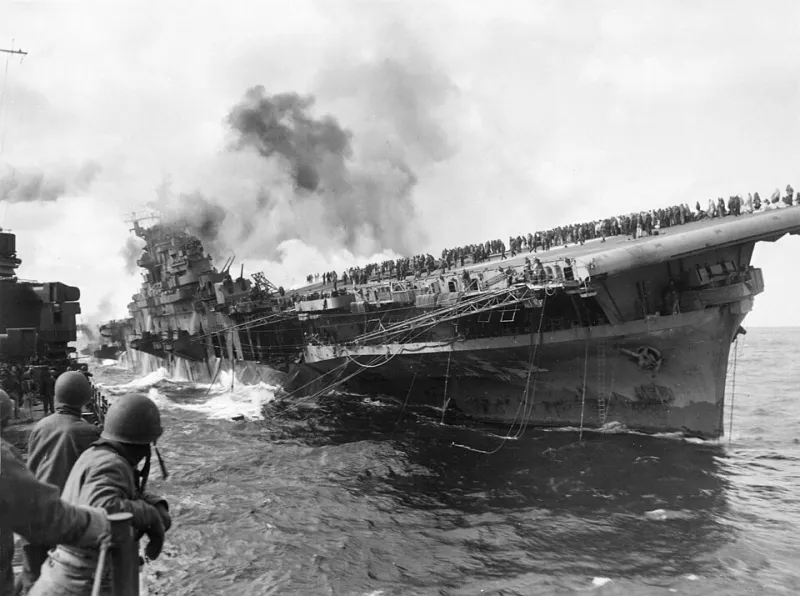
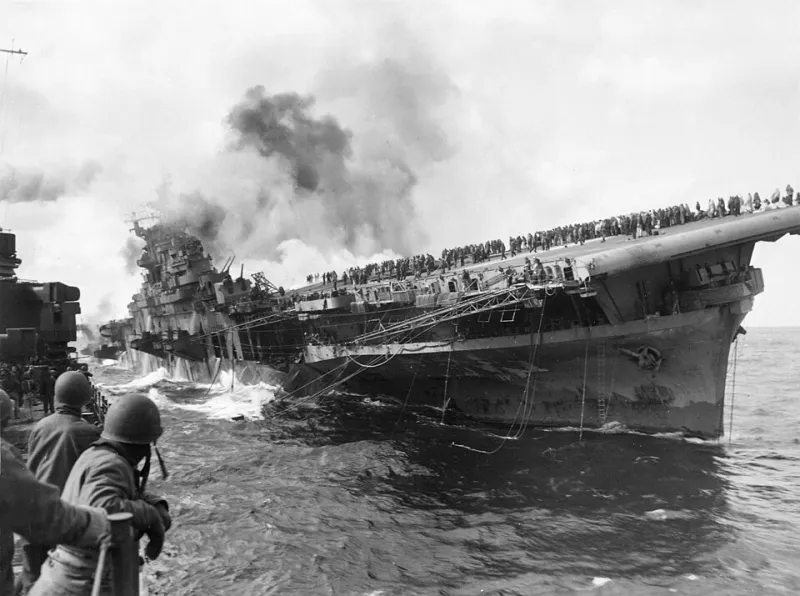
Photo: Photographed by PHC Albert Bullock Uploaded by User:Dna-webmaster to Wikimedia Commons Originally uploaded by User:Stan Shebs to English Wikipedia, Public domain, via Wikimedia Commons
The Pacific War was photographed on an industrial scale. Landing craft disgorged men onto coral; carrier decks boiled with aircraft; hospitals, harbors, and graves registration units all stood before lenses. Yet a camera could not always carry what a pencil could. The war’s combat artists—some official, some attached, some simply sketching between duties—left an archive of graphite, ink, and watercolor that records the Pacific conflict at a different focal length. Their drawings are not substitutes for photographs or after-action reports. They are a third witness.
The Pencil as a Front-Line Instrument
Combat art in the Pacific was not a single program. The Navy developed a combat art effort that sent artists into fleet and amphibious operations; the Marine Corps combined correspondents, photographers, and artists; Army art units and civilian correspondents added their own portfolios. Men such as Dwight Shepler and Mitchell Jamieson worked under naval auspices, while Tom Lea, on assignment for Life, accompanied Marines through Peleliu and produced images that remain among the most unsparing records of that campaign. Their assignments were not decorative. They were asked to see, and then to make seeing possible for people far from the line.
The conditions shaped the work. An artist in a foxhole had no darkroom, no tripod, and no guarantee of a second sheet of paper. He worked in short bursts, often from memory, often with the smell of diesel and coral dust still in his clothes. A wardroom sketch might be finished between general quarters alerts. A repair-dock drawing might begin while welders were still cutting steel. The result is an archive marked by interruption—unfinished edges, rapid notation, figures caught mid-gesture. That incompleteness is part of its value.
What the Camera Could Not Hold
Photography excelled at the factual surface: the geometry of a landing beach, the arrangement of aircraft on a deck, the identifiable face of a commander. Sketching excelled at texture and fatigue. An artist could isolate a corpsman’s cracked hands, the slump of a Marine waiting for the next order, or the particular gray of a destroyer’s repair party after a long watch. A lens might capture a hundred men; a drawing might explain one of them.
This is not to say that drawings are more truthful. They are filtered through the artist’s hand, mood, and politics. Official artists worked within censorship and service expectations; unofficial sketchers had their own angles. But that subjectivity is exactly what makes the sketchbook useful. It records not only what a scene looked like but what it felt like to look at it. In the Pacific, where heat, distance, and exhaustion often flattened experience into routine, the artist’s selective eye restored proportion. A fuel line, a helmet, a coffee cup, a stretcher—these objects become evidence of how the war was actually endured.
Reconstructing the Artist’s Eye in Motion
For PacificWar Animated, the sketchbook is a natural source for animated tableaux. The approach is not to colorize a drawing and call it a film. It is to treat each drawing as a layered document. A line-by-line reveal can show how an artist built a composition: the horizon first, then the landing craft, then the figures crouched behind cover. Parallax can separate foreground from background, letting the viewer see what the artist chose to emphasize. When a photograph of the same subject exists, the animation can place the two records in conversation—not to declare a winner, but to show where the camera and the pencil diverge.
After-action reports add a third layer. A drawing may show a destroyer alongside a damaged carrier; the report explains the hour, the damage, the number of wounded. Animation can move between those registers: the drawn image, the photographic frame, the typed sentence. In this sense the animated autopsy is an editorial act. It does not invent events. It isolates evidence and lets the viewer watch the artist’s choices unfold.
An Overlooked Visual Archive
The combat art of the Pacific War is scattered across service collections, museums, archives, and private papers. Much of it has been digitized; much has not. As of 2026, the Navy Art Collection and the Marine Corps’ art holdings remain essential starting points, but the full record is wider than any one institution. Sketchbooks, loose sheets, and marginal drawings often sit outside the headline collections. They are fragile, light-sensitive, and easy to overlook beside the era’s more famous photographs.
That oversight is a mistake. The sketchbooks show the Pacific War as a war of hands and waiting as much as a war of maps and maneuvers. They record the repair dock, the wardroom, the aid station, and the foxhole—spaces that photographs often visited but rarely explained. For an animated-history project, they are more than illustrations. They are scripts for movement, evidence of attention, and a bridge between the documentary record and the visual narrative.
The camera carried the Pacific War home in frames. The combat artist carried it home in lines. Both archives matter; together they allow the past to be seen, and then seen again.