Four Days, Three Hulls: Animating USS Batfish’s Undersea Ambush
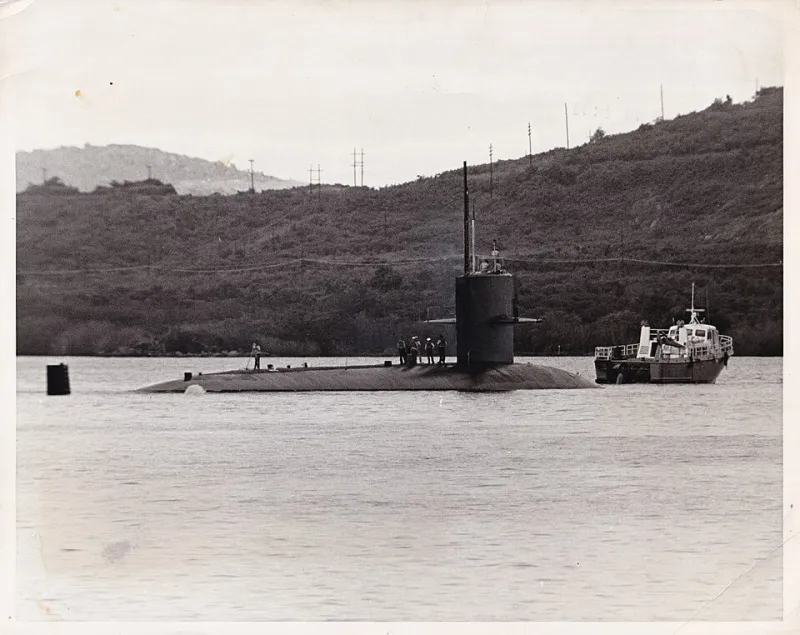
Photo: US Navy Photographer's Mate Chief Petty Officer C. L. Bassi, Public domain, via Wikimedia Commons
The Pacific War is often remembered through its carrier duels and amphibious assaults, but the undersea war produced its own strange inversions. In February 1945, the Balao-class submarine USS Batfish was reassigned from the familiar work of sinking Japanese merchant shipping to a narrower and more perilous task: hunting Japanese submarines. In a span of four days, Batfish sank RO-113, RO-112, and RO-115. No other American submarine matched that four-day run against enemy submarines. Animated reconstruction makes the achievement legible not as a tally, but as a sequence of night approaches, radar contacts, and torpedo solutions in which the hunter could become the hunted at any moment.
A Balao Boat Given a Different Mission
Batfish was a fleet submarine of the Balao class, commissioned in 1943 and built for long patrols against Japan’s maritime lifeline. By early 1945, American submarines had already helped cripple Japan’s merchant marine. The strategic problem had shifted. Japanese forces on Luzon still needed supply, and with surface routes increasingly closed, Japan turned to submarines as cargo carriers. The boats assigned to these runs were not intended for fleet engagements; they were pressed into a desperate logistics role.
Batfish was therefore pulled off the main commerce-raiding line and directed toward interception. That shift matters for the animation. A commerce raid usually unfolds against a predictable merchant route and a vulnerable target. A submarine-versus-submarine interception is a different geometry: both vessels can dive, both can detect, and both can disappear. The American boat’s advantage lay in radar, intelligence, and the patience to close on the surface at night.
The Undersea Lifeline to Luzon
The backdrop to Batfish’s patrol was the collapse of Japan’s surface supply system in the Philippines. After the Leyte campaign, Luzon became the next major objective, and Japanese planners sought to keep isolated forces supplied by any means available. Submarines carried food, ammunition, and personnel; they also evacuated specialists and other passengers when possible. These were dangerous, inefficient runs, but they represented one of the few remaining threads connecting Luzon to Japan.
Allied intelligence sought to cut that thread. Patrol lines and radio intelligence could place American submarines near likely routes, but the final encounter still depended on a commander’s ability to detect, identify, and attack a small, low silhouette in darkness. The RO-class boats used in these supply missions were not the largest submarines in the Japanese fleet, but they were still difficult targets: low in the water, capable of diving quickly, and operating under strict radio silence.
Reading the Night Through Radar
An animated autopsy of Batfish’s four days should begin with the radar scope rather than the torpedo tube. The boat’s successes came from radar-guided night approaches, the kind of attack that demanded a delicate balance between speed, silence, and positive identification. On the surface, a fleet boat could use its speed to run down a contact. But closing range also meant risking detection, and a submarine contact at night could be a friendly boat, a Japanese supply submarine, or something else entirely.
The reconstruction can show each engagement as a problem in relative motion. A radar contact appears at the edge of the scope. Range and bearing are plotted. The target’s course and speed are estimated. The American boat maneuvers for position, often running on the surface to gain bearing and speed. The torpedo solution depends on the target’s aspect, the firing range, and the run time of the weapons. Then comes the launch, the waiting interval, and the visual confirmation—often a flash, a column of water, or a radar echo that simply vanishes.
What the animation can convey better than a map is the compression of decision-making. The submarine commander has minutes, sometimes seconds, to decide whether the contact is worth pursuing and whether the attack is worth the risk. In Batfish’s case, the decisions produced three sinkings in four days. The patrol reports provide the skeletal geometry; animation supplies the spatial context that a written narrative cannot easily carry.
Three Hulls, One Record
The losses of RO-113, RO-112, and RO-115 were not merely three entries in a tonnage ledger. Each boat represented trained crew, scarce fuel, and cargo capacity that Japan could not easily replace in early 1945. The supply runs to Luzon were already a symptom of desperation; the loss of three submarines in rapid succession made the remaining routes more dangerous and the remaining crews more cautious. Batfish’s achievement also demonstrated what intelligence-directed submarine hunting could accomplish when a fleet boat was given the right patrol area and the freedom to pursue contacts.
Yet the feat was not a template for the rest of the war. Submarine-versus-submarine combat remained rare and uncertain. Most American submarines spent their patrols against merchant shipping, and most Japanese submarines were not engaged in supply runs. Batfish’s four days were exceptional because the strategic situation, the intelligence picture, and the commander’s execution converged. That convergence is exactly what an animated battle autopsy is suited to explain.
The Strange Symmetry of the Duel
There is a useful dramatic symmetry in the Batfish story: the submarine, a weapon built to hide and ambush, becomes the target of another hiding ambusher. The animation can shift perspective between the American boat’s radar plot and the Japanese submarine’s surface run, showing how each crew experienced the same patch of ocean differently. For Batfish, the enemy was a faint echo and a closing bearing. For the Japanese supply submarine, the threat might have been no more than a shadow, a radar warning, or a sudden torpedo track.
That symmetry also explains why the story deserves a place beside the more famous Pacific battles. It is not a carrier engagement, and it does not involve fleets of ships maneuvering under air attack. It is a small, lethal duel repeated three times in four days, with the ocean itself as the map and the radar scope as the primary source of drama.
A Record Worth Preserving
Today, USS Batfish is preserved as a museum submarine in Muskogee, Oklahoma. For American audiences, that physical survivor offers a useful anchor: the boat that hunted three Japanese submarines in four days can still be walked through, its compartments and equipment interpreted for visitors. Animated history can then extend the museum experience beyond the hull, reconstructing the night approaches and the strategic pressures that sent Batfish into the Luzon Strait.
The four-day run of February 1945 is not as celebrated as Midway or Leyte Gulf, but it belongs in the same conversation about how the Pacific War was actually won. It shows the submarine war turning inward on itself, with one hunter becoming another’s prey. And it shows why animation, with its ability to visualize range, bearing, and time, is well suited to recovering a battle that most viewers will never see in a photograph.