Pint by Pint, Island by Island: Animating the Pacific War’s Transfusion Pipeline
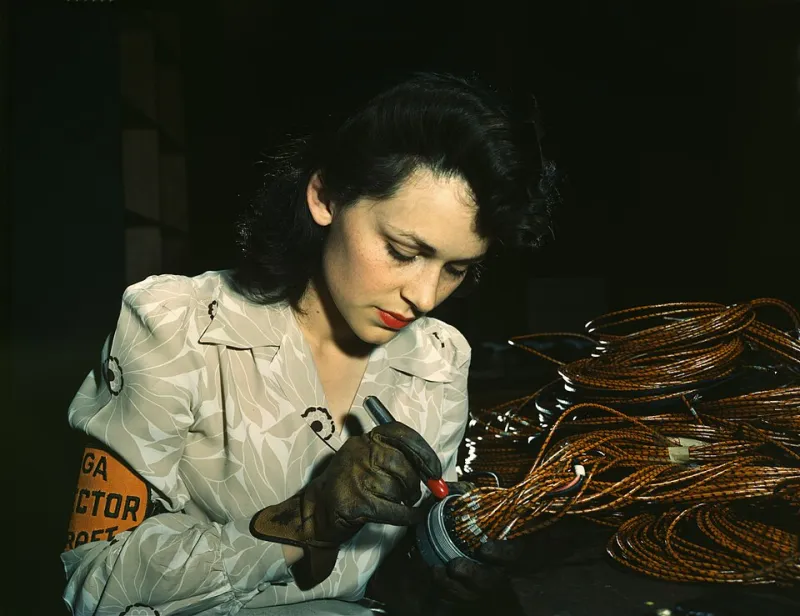
Photo: Bransby, David, photographer., Public domain, via Wikimedia Commons
In an animated reconstruction, the camera would begin not at a battlefield but at a folding table in a church hall in California. A volunteer rolls up a sleeve. A nurse labels a bottle. A crate is packed with ice. Then the map pulls back, and the pint begins to move—by truck, by air, by ship, by hand—toward a Pacific island whose name the donor may never learn.
That journey is the subject of this animated autopsy of the Pacific War’s blood supply. The usual story of battlefield medicine focuses on surgeons, plasma bottles, and dramatic transfusions. Those elements matter. But the Pacific War added a harder problem: distance. Blood and plasma were perishable, temperature-sensitive, and needed at places that were often weeks from the nearest American city. The result was a pipeline in which medicine, shipping schedules, refrigeration, and combat timing collided.
From Donation Center to Staging Depot
The U.S. blood program did not begin as a single Pacific-focused system. It grew from civilian donation drives, Red Cross collection centers, military laboratories, and naval medical depots. Early in the war, dried plasma offered an advantage that whole blood did not: it could be stored and shipped without refrigeration. Plasma expanded blood volume and bought time for wounded men in shock. It was not a substitute for every need, but it was portable, stable, and suited to the first years of a war fought across enormous ocean distances.
Whole blood was more demanding. It required refrigeration, careful handling, and a limited shelf life. As collection and transport improved, whole blood moved farther into the Pacific, especially in the war’s later campaigns. But it never became routine in the sense that a crate of ammunition was routine. Every pint carried a clock.
Our animation would show the home-front geography first: donor centers, laboratories, packing stations, and airfields. Then it would follow the route westward. San Francisco served as a major port of embarkation and a gateway for medical supplies moving to Hawaii and beyond. Pearl Harbor was not merely a battle site in this story; it became a reservoir and transfer point, where refrigerated storage, hospital capacity, and shipping schedules determined what could move forward.
The Harbor as a Medical Reservoir
At Pearl Harbor, the blood pipeline met the fleet. Supplies arrived from the mainland, were stored, and were redistributed according to operational need. The animation would render this as a pulsing node rather than a static dot: incoming shipments, outgoing requests, cold-storage limits, and the constant uncertainty of when a convoy or aircraft would depart.
From Hawaii, the chain stretched to forward bases and mobile medical units. Not every pint traveled the same route. Some plasma went by ship in dry form and was reconstituted near the front. Whole blood moved in refrigerated containers when transport and storage allowed. Casualty stations and field hospitals kept small supplies on hand, but they depended on a rear area that was itself often undersupplied.
This is where the Pacific War’s blood story becomes distinctly logistical. A hospital might have surgeons, nurses, and plasma, yet still face a shortage because a shipment was delayed by weather or because a refrigerator failed in tropical heat. The medical problem was real, but the binding constraint was often transportation.
One Marine’s Chain
To make that abstraction visible, the animation would follow a representative wounded Marine—a composite figure drawn from the pattern of casualty records rather than a single named individual. He is hit during an assault in the final year of the war. A corpsman applies a dressing. He reaches a casualty station. A surgeon calls for blood or plasma. A bottle is taken from a refrigerated box, checked, warmed if necessary, and hung on a stand.
The chain behind that bottle is longer than the moment suggests. It includes a donor in the United States or Hawaii, a collection team, a laboratory technician, a packer, a truck driver, a cargo officer, a ship’s medical department, and a forward supply clerk. Each link had its own failure points: contaminated batches, broken cold chain, mislabeled crates, delayed ships, and the simple difficulty of finding one box among thousands.
The animation would deliberately slow down at the transfusion. The map recedes. The screen shows the bottle, the tubing, the wounded man’s face, and then pulls back again to reveal the ocean crossing that made the bottle possible. The point is not to diminish the drama of the transfusion. It is to show that the drama depended on a supply line that was itself under pressure.
Time, Temperature, and the Tyranny of Distance
Animated isochrone maps would make the central problem clear. A donation center might be days from a port, the port weeks from a forward base, and the base hours or days from a casualty station. Whole blood’s shelf life shrank that map. A route that looked reasonable on a shipping chart could be impossible once refrigeration, handling time, and combat demand were added.
Dried plasma relieved some of that pressure because it did not need the same cold chain. But plasma could not do everything whole blood could. The medical services needed both, and the mix changed as the war moved closer to Japan. The pipeline had to be flexible: plasma for storage and forward portability, whole blood where refrigeration and faster transport allowed.
What the Pipeline Explains
The Pacific War’s blood supply is often remembered as a medical achievement, and it was. But it was also a home-front achievement and a shipping achievement. Donors in American cities, nurses in collection centers, refrigerated storage at Pearl Harbor, and cargo officers in the Pacific all belonged to the same system. When the system worked, a wounded Marine received a transfusion that seemed almost ordinary. When it failed, the failure appeared at the casualty station as a shortage.
For PacificWar Animated, the value of this story lies in that dual perspective. The camera can show the human moment at the bedside and the vast map behind it. The pint is not just a medical product. It is a schedule, a temperature, a shipping decision, and a promise that the home front made to the front lines—one that had to be kept across an ocean.